Showing posts with label transparencies. Show all posts

Sunday, March 10, 2019

Ships at Harbor: Seascapes in Needle Arts, Part IV

Claude Monet,  fishing boat at anchor at Rouen
Claude Monet,  fishing boat at anchor at Rouen
A painting, whether super-realistic or abstract is made up of shapes. To be interesting, the shapes should have rhythm, variety, and an element of surprise or unpredictability. That's quite a balancing act!  Rhythm implies repetition; too much repetition is boring and the viewer loses interest.  Variety suggests a collection of differing shapes, but this may be confusing or even irritating to the viewer.  (Haven't you ever seen clothing or upholstery material that you felt was too ‘busy’ for your taste or been in a room that was so cluttered that you didn't feel comfortable in it?)  Surprise means something unexpected introduced into the scene, but it probably should not be something so incongruous that it takes a viewer's mind completely away from the picture as a whole.
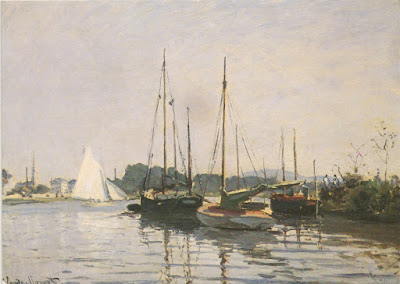
Claude Monet, sailboats
Look at the harbor scene above and notice how well the artist has used his shapes.  See how the strong vertical shapes of the masts and the fainter diagonals of the rigging rhythmically break up the horizontal areas of the water, the line of trees, and the passive sky with its barely suggested clouds. The shapes and colors of the boats' hulls add variety, as do the ripples that break up the mass of the water and provide a second area of rhythm.  The bright white sails of the boat in the background give us that element of difference and focus our attention.  The artist was Claude Monet, leader of the Impressionist movement. Although he is not known primarily for marine paintings, he did a number of them. (Another one of his is shown at the top of this article.) He was fascinated by the effects of light on water and continued to use them in his paintings throughout his entire career.
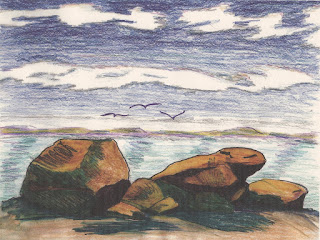
Sketch of an approaching storm by Annake
Sketch of an approaching storm, by Annake
There are some generalizations that we can make about shapes and areas in a composition (always remembering that rules are made to be broken.)  The large horizontal areas of sea and sky are generally considered as negative spaces and passive shapes unless something active, like a storm, plays out against them. In the preliminary sketch to the right, the clouds and the wavelets beginning to form on the surface of the water are active, carrying the energy of the fast-approaching storm. Vertical and diagonal shapes are generally considered to be active and positive.  Something like a tree is more "active" than a nearby boulder.  If a scene is dominated by horizontal areas and vertical shapes or lines, diagonal shapes like the white sails on the boat are often added to the scene for contrast. Curved shapes like rolling hills are more passive; turbulent curved waves or breakers are very active.  Too many passive shapes can make a composition seem dull, even though it is attractive in other ways.
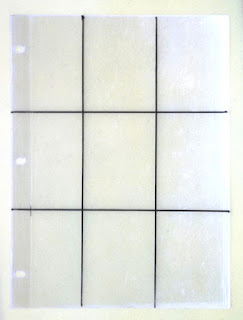
Rule of Thirds grid tool
An arc can be a powerful shape in a composition, particularly if it is at the edge of a point of interest, such as one of the focal points where the "Rule of Thirds" applies.  This plastic overlay, which we showed first in Part V of the Landscape series, works just as well for seascapes as it does for landscapes. We show it here the portrait position (in contrast to the landscape position we presented the first time). If you have not yet made this handy tool, now is a good time to do so.  You only need a sheet of clear plastic, a ruler or other straight edge, and a marking pen. Divide the plastic sheet into thirds, both vertically and horizontally, and mark the four points of intersection. Your primary point of interest in a composition should be at or near one of these points.  A secondary point of interest, if you include one, should be at or near the point diagonally across from the primary one.
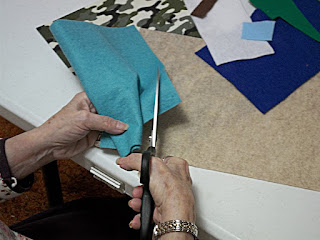
Cutting felt shapes
A shape that may be interesting by itself can get lost in, and be neutralized by, other shapes unless it is supported by color and contrast.  If a shape that you are using is distracting from, or not contributing to, your composition, try moving it. If that doesn't work, remove it. This is especially true if you are doing a composition in applique. Before you stitch anything to a background,  be sure that the shapes that you have chosen to cut out are really contributing to the design.  When you are satisfied with the arrangement, pin it in place and check it one more time before you begin to stitch. View it from a distance as well as at close range. If you decide that a piece isn't right after you have sewn it in place you may be unwilling to remove it, even though it weakens the design.

I know that some of you are concentrating on lakeside or riverside scenes, rather than true seascapes. You can certainly put sailboats, motorboats, rowboats — even rafts and inflatables — into those compositions to give variety and points of interest that counterbalance the landscape and water.
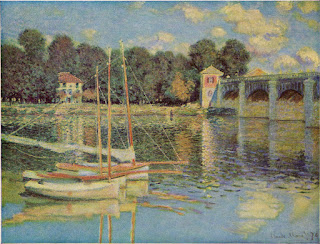
Claude Monet, "The Bridge at Argenteuil"
Here is another Monet painting, obviously portraying an inland waterway, which may give you some ideas. Notice how the boats cover the primary point of interest at the lower left (when the plastic overlay is in the horizontal position), while the towers on the bridge are close to the secondary point of interest, diagonally at the upper right. The bridge itself moves away in a slightly diagonal line, and the arches and reflections introduce another rhythm. A more passive rhythm is created by the variety of shade trees in the background.  The other building in the scene occupies a place close to the point of interest on the upper left, but is less "positive" than the other two.

It is all too easy to get so interested in the smaller positive or "active" features of your composition that  you neglect the larger negative or "passive" parts of it. But they are equally important to the success of your design. You have just seen me making shapes and I have emphasized the importance of their arrangement for applique projects. They are also important for embroidery projects where the background fabric(s) will show between the areas of embroidery.  In my tapestry work I often do three-dimensional, even padded, stitching on top of a background of tent stitch or other essentially flat stitches, so I'm always planning my backgrounds first. Here is a simple technique that I use when I am working on an unpainted canvas. I have used it successfully as a teaching technique with school-age children as well as older students.
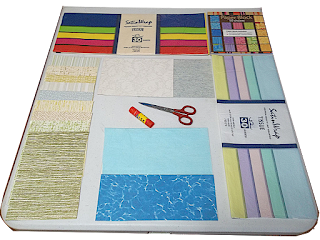
Examples of materials needed for the exercise
First collect all the colored paper that you can find: stationery, poster paper, wrapping paper, tissue paper, colored newspaper advertisements, etc. You will need scissors and a glue stick or other adhesive. Cut a piece of heavy paper, poster board, or cardboard in the size and shape that you want for your final design. Work first with the two large ares of your seascape. Will the sky be light blue, bright blue, dark blue, light gray, dark gray, or sunset colors? Cover the area you have designated as sky with the appropriate colored paper. Do the same thing with the part of the picture that you have reserved for the sea. When you are satisfied with the proportions of these two areas, glue them to the background.

Think about ways that might make these areas more interesting. Can you put in tall, impressive clouds or sweeping, diagonal ones? Is there an island or headland in the area where sea and sky meet? Is it rocky, with hard shapes, or soft and rounded? Is it grass-covered or does it have trees?  Are the tress broad-leaved trees, evergreens, or palms (each has a different outline)? What is at the bottom of your picture? Rocks, a sandy beach, a jetty? Cut pieces of paper in the shapes and colors of the appropriate features and place them on your background, but do not glue them to the background.
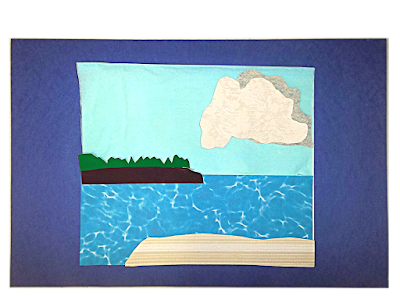
Mock-up of a background using cut shapes

Now cut out the positive, active features that you planned your composition around. Position your pieces where you think they will be most effective.  Again, do not glue them to the paper. Then reconsider the shapes you put in during the second stage of this process.  If the pieces do not contribute to the design, move them. If they still don't help, remove them. Glue in place the features of this group that you want to keep. Now reconsider the entire composition.  Are your positive pieces completing the design the way you intended? When they are doing that, glue them in place.

Congratulations! Now you have a good "working model" and are ready to begin creating with your choice of materials.

Keep up the good work!


Claude Monet, Regatta in Argenteuil

 Creative Commons LicenseThis post by Annake's Garden is licensed under a Creative Commons Attribution-NonCommercial-ShareAlike 3.0 Unported License.

Saturday, May 21, 2016

BUTTERFLIES, BUTTERFLIES, BUTTERFLIES!

latch hooked butterfly wall hanging
A reader recently wrote: “I love butterflies! Your wall hanging is so pretty! Thank you for the pattern. How do you go about designing and how do you make charts from your designs?”

I love butterflies, too! Thank you for the compliment, and you're most welcome for the pattern (March 21, 2016). It can be used for several types of needlework. You have asked about one of my favorite subjects designing. Before I get started on a new design, I do research. I look at photographs of my subject, as well as scientific illustrations (if it is a living thing), paintings, even cartoons. Each photographer or artist sees and emphasizes something different in his or her pictures, so I get more details from looking at many sources. This photograph shows some of the things I looked at while I was considering butterflies.

butterfly samples pictured


I wanted butterflies of three different shapes and sizes for the wall hanging. Once I made my choices, I made enlarged cutouts of their shapes. To make the butterfly shapes show up even more, I glued them to sheets of dark blue paper.

butterfly silhouette on blue paper

Before I did that, however, I traced the butterfly outlines onto pieces of quarter-inch graph paper.

butterfly silhouette on graph paper

Then I made the squares of graph paper match the curves of the designs as well as I could sometimes stopping just inside the butterfly outline, sometimes drawing just outside it. I marked the squares with letters or symbols representing the colors of the butterflies. Then I made a little “key” for each butterfly, telling what each letter or symbol represented.

butterfly pencil chart on graph paper

I then filled in a second graph paper silhouette for each with the colors of the butterfly, making small adjustments as needed. I used markers because the colors are more vivid, but colored pencils are easier to erase, so you may choose to use them. 

butterfly chart colored in

Then I used my paper patterns to make the latch-hook pictures. I chose colors of cut rug yarn that were the closest color matches for the marker shades. If I wanted to do the same designs in counted cross-stitch, I would start with graph paper that had much smaller squares so I could get much finer details into the picture.

latch hooked section done from colored chart

When we get a little time, I’ll ask J.D. to work his magic and turn my simple chart into a professional color-coded chart that you can download. Look for it in a future post.

Another reader commented:”You mentioned sewing tabs on the reverse applique butterfly (April 10, 2016). Can you show me what you meant?”

Certainly. Here is a  pictures of the finished butterfly ready for framing or to be prepared for hanging. I decided to make it a small wall hanging. The first thing I did was to cover the back of the entire rectangle with another piece of felt. This made it feel solid and caused it to hang straight and flat.

butterfly reverse applique

I then cut straight strips of the darkest color of felt, folded them in half, and sewed them to the back of the rectangle. I planned to glue wooden beads to a small-diameter wooden dowel and slip the beaded dowel through the felt tabs. Once I had it centered, I would have inserted a screw-in hanger into the top center of the dowel and it would have been ready to hang on the wall. However, I purchased a black wire hanger on sale from Herrschners.com that seemed just right for the butterfly. You can see the finished project below.

butterfly reverse applique with tabs and hanger
As you can see, this butterfly is not like any living species! Butterflies and moths have such intricate patterns that they stimulate the imagination. It is easy to dream of fantastic ones.


butterfly pillow top
Here is a picture of a fantasy butterfly made in French longstitch with back-stitched outlines, against a striped “sky” done in tent stitch. For more information about French longstitch, see the post for March 8, 2015. The piece was designed for a pillow top.
.

butterfly transparency in hoop
And for a butterfly that can really “fly” in an open window or doorway when there is a breeze, look at this little “Window Wonder”. For the directions to make one like it, see the post for April 29, 2015.

And, finally, a picture of a real, live butterfly, courtesy of J.D.'s sister, J.J., who is also an enthusiastic photographer.

Best wishes to butterflies and butterfly lovers everywhere,


colorful butterfly photo by jljardine

 Creative Commons LicenseThis post by Annake's Garden is licensed under a Creative Commons Attribution-NonCommercial-ShareAlike 3.0 Unported License.

Wednesday, April 29, 2015

Window Wonders: Art Transparencies

orchid transparency
Orchid transparency, marker on organza
Some of you are stay-at-home parents with small children, home-schooling parents or grandparents, or parents/grandparents who help children with their schoolwork. These attractive transparencies are easy to do, made with inexpensive materials, and something you and the children can do together. Suppose your children are learning about flowers, insects, seashells, or airplanes. As an accompanying activity, why not help a child make a transparency of one of the objects he/she has been studying, to illustrate an oral or written report, and to have something to hang in a window afterward. When the child tires of the picture, it can be replaced by one on another topic.

hibiscus sketch
Hibiscus sketch
Before you a do a project with children, however, you might make a transparency of your own. Then you can guide a child through the project (and impress them with your talent). I prefer to work from my own sketches, like this one of a hibiscus flower. I sketch the picture in pencil, putting in all the shading. Then I outline it in permanent marker to make it easier to trace onto parchment or fabric. If you don't feel comfortable doing that, there are always pictures you can trace. Coloring books are a good source of these. Dover Publications, Inc. has dozens of great coloring books on all kinds of subjects (www.doverpublishing.com). The illustrations are detailed and accurate. There is no charge for using these illustrations, nor do you need to get permission to use them, so long as you don't use more than ten of them in any one project. Or trace calendar, catalog, or magazine pictures.

Orchid samples
Orchid samples
Start with a simple outline drawing or tracing. Go over the outline with a black permanent marker (I used a Sharpie®). You will need a piece of white organdy, non-woven interfacing, nylon organza (or silk, if you can find it), woven interfacing like buckram, parchment paper, tracing paper or some other sheer material. (Parchment paper is found where baking supplies are sold; it is rolled, so press it lightly with a warm iron to flatten it.) Make sure that the material you use will accept crayon or marker. (If you use interfacing, get the firm kind that is slightly rough on one side and smooth on the other, not the soft kind that feels fuzzy. Don't use iron-on interfacing.) Press the material with the appropriate iron temperature. (If you have not worked with nylon or silk before, be aware that they are slippery; tape the edges to cardboard before you begin coloring especially with crayons.) Protect your work surface so no marker comes through to it. (Marker should not come through parchment; however, you will not get brilliant colors with it.) Trace the outline onto the fabric or paper with a black or dark fine-point marker. Color the picture with permanent markers, washable markers, or rather heavy applications of crayon. Once a picture done in marker is dry, it is ready to be framed.

Butterfly transparency
Butterfly transparency on interfacing
A crayon picture, however, requires an additional step. Place a couple of layers of heavy paper or paper towels on top of a pad of newspaper. Put the picture, face-up, on top of this. Place more layers of white paper or paper towel on top of the picture. Press the whole thing with a dry iron at the heat setting for cotton, being especially careful not to scorch nylon or silk. Press until all the wax from the crayons has been absorbed and only the color remains. Keep checking the layers, changing the paper as needed. You should do this step for the children. If you allow them to watch, stress safety. When no wax remains and the fabric has cooled, your transparency is ready to frame.

Hibiscus transparency
Hibiscus transparency from sketch, crayon on organdy
I like embroidery hoops for framing. The hoop should be a little larger than your picture, but smaller than the parchment or fabric around the picture. Plastic hoops come in many bright colors. The outer half of a wooden hoop can be stained, varnished or left alone. Be sure that any finish is completely dry before you secure the picture in the hoop. Be particularly careful with parchment or tracing paper.. Center the picture over the bottom half of the hoop. Position the upper half so that the adjusting screw is directly above the center of the picture. Press it down over the fabric and pull it as taut as possible. Turn the hoop over and cut away all the excess with scissors. Secure a hanging thread around the adjusting screw. Hang the picture in the window where the light will shine through it with the colored side facing out. If you use plastic fishing line or clear nylon thread to hang it, the hanger will be nearly invisible and the picture will appear to “float” in the air. If you prefer a picture frame, select a light-weight one without backing or glass. Remove any staples from the back. Cover the back edge of the frame with a white glue (like Elmer's). Stretch the parchment or cloth, face-down, over the back of the frame and press it against the glue. Let it dry completely. Cut off all excess. Put a screw eye in the top center of the frame.  

Workspace with markers
Older children will probably prefer to work with markers. I use Sharpies®, but Crayola® makes a large variety, including washable ones. You will, at least, need black, brown, dark blue, light blue, yellow, orange, light green, dark green, pink, red, and purple. White areas should not be colored. Protect the working surface. Remind the children to replace the caps on the markers tightly when they are not in use so the pens will not dry out. Make cleaning up and putting away materials an important part of the project.

Workspace with crayons
I encourage young students to peel the paper off the crayons so that they can use sides and blunt ends as well as the points. Crayons are not expensive, but it pays to get good quality, like Crayola®. Parchment paper is not very good for crayon; you would do better to use tracing paper. If it will not mar the work surface, you may want to tape their pieces of paper or fabric down with masking tape before they begin to draw. If they are working on cloth, they will need to press harder to draw lines and to color areas more heavily than they would on paper. They may need some help with this. They may outline parts of their finished pictures with a black or other dark crayon so that it shows clearly. Keep all the crayons even the broken ones because we will be doing some crayon batik later this year.

Enjoy the teachable moments,


Hummingbird transparency
Hummingbird transparency in a 4" embroidery hoop


 Creative Commons LicenseThis post by Annake's Garden is licensed under a Creative Commons Attribution-NonCommercial-ShareAlike 3.0 Unported License.

Contact Us

Name

Email *

Message *

Blog Archive