Showing posts with label useful plants. Show all posts

Sunday, July 16, 2017

Questions for the Garden Gnome

(In order to give Annake some time to finish bits and pieces of projects and samples for upcoming posts, this time we are dragging the Garden Gnome out of his hole to answer accumulated  garden-related questions that have piled up since the end of last growing season...)

clary sage
Clary sage in the herb garden
How did the planting in the straw bales go?

It ended with mixed results. It depended upon how much water I could get to each one. The ones around the former compost pile did exactly what they were supposed to do and have all but disappeared. The remains can be mixed into the compost or plants can be planted into them directly. The ones that were half-successful will be broken down into compost or used as mulch on the raised beds.

all that's left of composted straw bales
All that's left of properly composted straw bales

straw used as mulch in the raised bed
Leftover straw used as mulch in the raised beds


Unfinished bales for garden border
Unfinished bales for garden borders
Are you going to do it again this year?

There were some bales that were placed too far for the soaker hoses to reach. They are largely intact. A few of those will be used this year as borders for other planting areas. They will get water when the interior plantings are watered and I will experiment with planting seeds in them again. However, the current severe drought will determine how much water we can use for that purpose. The rest may be made into compost.


What happens to the straw bale after you harvest the plants?

They disappear. They become dirt. This is a good thing, because good dirt is expensive and straw is cheap.

fennel
Fennel
Are you selling any new and different herbs this year?

Two, fennel and clary sage. Fennel isn't really supposed to over-winter here, but ours didn't “get the memo”. Maybe it was the hay bales? Fennel, a member of the carrot family, has been used from ancient times. Roman soldiers ate it to give them strength and spread its seeds across Europe. Roman women used it for slimming. The Anglo -Saxons revered it so much they even used it as a charm against evil. It is popular in Mediterranean cooking. Fresh leaves and stems are used in salads, sprinkled over meat and fish dishes, and used in sauces. Like dandelions, all parts of the plant are edible. The roots (bulbs) can be eaten like celery or thinly sliced for salads. For a recipe and suggestions for use of this herb, see Annake's addition at the end of this post.


dandelions
Much maligned, but wonderfully versatile dandelions
Speaking of dandelions, most people consider dandelions as weeds, but they don't know about the plant's good qualities. For example, the flowers are used for flavoring wines and liqueurs. The leaves are edible if you use young, fresh ones. (Please don't spray the plants with anything if you plant to use any part of them!) The roots can be roasted to make a hot beverage, although I recommend that you add other ingredients. The roots also break up hard ground and the plants seem to prefer hard ground. I seldom find a dandelion in a prepared bed. I'm perfectly willing to let them break up the hard ground for me. The flowers make a slightly orange-yellow dye and the roots make a russet brown one. Besides, the flowers brighten up the world when few other flowers are blooming.

Clary sage (pictured at the top of this post) is a very old herb, also originally from the Mediterranean. For those of you who know the folk song (or remember the Simon and Garfunkel rendition) Parsley, Sage, Rosemary and Thyme may be interested to know that it not our Thanksgiving sage is the “sage” meant in the song. It can be used fresh or dried to flavor breads, stuffing, cheese dishes and vegetables. Its aroma and flavor are much more like its mint relatives than our Thanksgiving sage. It has attractive spikes of lavender flowers. Annake tells me that it is used as a fixative in perfume-making and is really nice in home-made potpourri. She also says a few crushed leaves in your bathwater makes for an invigorating soak. (I'll take her word for that.)

oregon holly grapes
Oregon holly grapes
Are the fruits of the Oregon holly-grapes edible for people, too?

Yes, but they are really sour! With enough sugar, they taste a lot like vine grapes. I recommend mixing them with vine grapes to make an interesting, tart jelly. They are loaded with Vitamin C.

What can you do with rose hips?

These are also sour and also an excellent source of Vitamin C. Once removed from the rosebush, they dry quickly and keep for a long time. Early settlers used them to ward off vitamin-deficiency diseases like scurvy. They are commonly used in teas and jellies.


columbine
Our new columbine
Did you ever find out what this year's gift from the birds was?

Yes, in fact we found two. The first was a handsome pink and yellow columbine. I think we have shown you a picture of the cream-colored one they left us a couple of years ago. (April 20, 2017 post) The second was a pink sweet pea vine coming up in the rock pile near where Rasputin, our rhubarb, lives and plots world domination.

Now, go grow something and make the world a better place...

J.D., Annake's Garden Gnome


Annake's Recipe
 for
Grilled Fish with Fennel

Clean and salt the fish. Lightly stuff it with fresh chopped fennel and sage. Slit the sides of the fish twice. Coat the fish with oil. Make a bed of fresh fennel stems and leaves in a pan. Put the fish on top. Cook, turning the fish and brushing it with oil. Serve garnished with slices of lemon.

Fennel is especially good with bass, but also with other fish, especially fatty ones.

Other Uses for Fennel:
  • Snipped fresh leaves or minced stems are good additions to salads. Try them sprinkled over fish, pork, cheese, eggs, beans, lentils or rice. Add the fennel just before serving.
  • Fennel is good with dishes of any of the cabbage family: broccoli, cauliflower, Brussels sprouts, etc.
  • Add 3 T. of freshly chopped fennel to an omelet of 4 to 6 eggs.
  • Add sprigs of fennel to canola oil, extra-virgin olive oil, or saffron oil for a tasty cooking oil.
  • Use 1 T. chopped fennel to flavor butter or mayonnaise.
  • Fennel roots and lower stems can be cooked and treated like carrots or new potatoes.
  • Use fresh fennel flowers, which have a delicate licorice (anise)fragrance. Mixed with nasturtiums and calendulas, they make a pretty bouquet and you can eat it as a salad, too!
  • Make a fennel sauce with ½ cup mayonnaise, 1 T. light cream, and 1 t. chopped fresh fennel leaves and stems. Good over fish.



Sweet pea
Sweet pea, bloomed out and ready to move to a better location

 Creative Commons LicenseThis post by Annake's Garden is licensed under a Creative Commons Attribution-NonCommercial-ShareAlike 3.0 Unported License.

Thursday, April 20, 2017

Be Kind to Your Fine-feathered Friends

Garden scene with birdbath
Late spring afternoon in Annake's garden
Many years ago when I was in high school, we used to sing a silly song to the tune a rival school had chosen for its athletic “fight” song. It started like this:

“Be kind to your fine-feathered friends,
For a duck may be somebody's mother,
Who lives all alone in the swamp,
Where it's always dark and damp...”

or something to that effect. That silly song was on my mind this morning while I was looking for this year's “gift” from the birds.


End-of-season grapes left on the vine for the birds
We joined the National Wildlife Federation's backyard wildlife program several years ago. We provide cover, food supplies, and water year around. Since our backyard is of a modest size, most of the creatures that benefit are birds and small animals like toads. When I first moved to this area, there were very few species of birds. They had suffered from DDT poisoning. There was a later set-back when West Nile virus attacked the state. For the past several years, however, we have noticed at least one or two new species moving into our neighborhood, or migrating through it, every year. And they come bearing gifts! Each year we find at least one plant growing here that we didn't plant ourselves. Some are annuals, which grace us with their presence for a year and then are gone. But others take root and become permanent residents.


Oregon grape holly in bloom


This beautiful Oregon holly grape started out as a tiny seedling,. Today it is as tall as I am and it takes at least four people to join hands around it, while staying out of its prickly leaves. Each year it produces balls of bright yellow flowers, followed by deep blue berries that help us feed the birds through the following winter.


Evergreen tree


This evergreen came along soon after the holly grape and stands beside it. The first couple of years the poor little thing was eaten nearly down to the ground by the deer. As its prickly neighbor grew bigger and broader, however, the deer learned to leave it alone. Now it is several feet taller than its protector.


Rose hips


Birds that like rose hips have provided us with several wild, or pasture, roses. One has made itself at home on the side of our small lean-to greenhouse. It produces fine new hips each autumn that we use as a source of Vitamin C.


But our prize gift has been this lovely cream-colored columbine. We have planted columbines in other places, but none have been this color or have had blossoms this large.

White columbine
Creamy white columbines

Crabapple blossoms
Crabapple blossoms

We share our fruit with the birds. They eat the fruits of this crabapple tree all winter long. The tree is old, but still produces these colorful blooms and many red fruits. A flock of cedar waxwings stops during their autumn migration to fill up on them.


Berries on the snoball bush
Berries on the snowball bush

The lively little bushtits stuff themselves with the fruits of our snowball bush. Like the evergreen, this plant had a difficult start because it was trampled the first couple of years. Now it is so big it seems to think it is a tree! We also leave some apples on the tree and grapes on the vine for the birds to feed on during the winter.

Red Delicious apples on the tree

One of our neighbors keeps geese. On warm, sunny days they wander around the neighborhood, eating lots of insects, scaring the stray cats, and even keeping the deer away. J.D. got this photo of them marching down the middle of the street.

Local geese on the march
Geese on patrol

Did I find this year's gift? Not yet. But I will. I always do. I'll just keep looking. And I'll put out a string bag of yarn and dryer lint for nesting materials. So my message to all of you is to be kind to the birds and perhaps they will bring you presents, too.

Oh, you wanted a duck, too? Below is one I did in petit point when my eyes and hands were a bit younger.

Love the birds. (Yes, J.D., even the pigeons.)


Needlepoint of wood duck
"Mandarin Duck," available in our Etsy shop

 Creative Commons LicenseThis post by Annake's Garden is licensed under a Creative Commons Attribution-NonCommercial-ShareAlike 3.0 Unported License.

Monday, February 27, 2017

Our Fourth Anniversary Edition

cake with four candles
It is time for our annual anniversary post. How time does fly! It hardly seems possible that we are beginning the fifth year of this blog! First of all, I want to welcome the new nations that joined our readers this past year. They are, in alphabetical order: China, Ecuador, Egypt, Estonia, Guatemala, and Swaziland. We are so happy you have chosen to “visit” us. The little blue maps that we used previously were not doing justice to lovely small countries like Luxembourg. (I have fond memories of my visit there.) So we have put a large world map on the wall by my desk. I mark each country with a paper dot.

photo of world map from Annake's office
Photo of world map from Annake's office


Lemon balm growing in Annake's Garden
As Spring draws closer, we are getting ready to plant vegetables and herbs for the seasonal Farmers' Markets. Annake's Garden is earning a good reputation for its fresh herbs. One of the things that we do is to supply a sheet of simple recipes and tips for using each herb to first-time buyers of that herb. We would also like to share some of these recipes with you. One of the most popular herbs we introduced last year was a favorite of mine lemon balm (Melissa officinalis). These two easy recipes got great reviews. Look for more recipes during the coming year.


Lemon Balm Simple Syrup

1 C. sugar                  1 C. water             3 C. chopped lemon balm leaves

Boil water and sugar until sugar dissolves. Add lemon balm. Simmer another 5 to 8 minutes. Remove from heat. Let cool for 30 minutes. Strain syrup, discard leaves.* Refrigerate in a tightly-closed container.

* Leaves can make a second batch of syrup if used right away.


Lemon Balm Coolers

¼ C. lemon balm syrup                                              1 tsp. Lemon extract
½ can lime juice concentrate                                     5 ounces club soda
2 C. crushed ice

Combine the ingredients in a blender and blend until smooth, Serve in chilled glasses. Garnish with lemon balm sprigs if desired.


parsnips
Parsnips
I don't know if you follow health food news, but one of my favorite vegetables is getting very favorable mention for its nutritional value. That vegetable is the parsnip. (Brassica rapa) It is one I use a lot, especially in slow cooker (crockpot) recipes. With our demanding schedule, we depend on having this kind of hot meal waiting for us at the end of the day. You can use parsnips in recipes that call for carrots, turnips, or other root vegetables. If you haven't tried them yet, I hope you will do so soon. Look for more about herbs and/or other food plants later this year.


Applique on sweatshirt
Applique on one of the sweatshirts in our Etsy shop
I am always pleased when new needlework or art topics get a good response. I was gratified by the interest in Swedish weaving, optical illusion needlework, and reverse applique. There will be more information and patterns this year for all of those topics. Another thing I hope to begin this year is a series of articles relating the characteristics of kinds of art work to their applications in needlework, starting with still life. Sometimes I am pleasantly surprised by the interest in a particular post. That was the case with the one about decorated sweatshirts and the follow-up post about jackets made from sweatshirts (November 30, 2016 and December 15, 2016). I will try to include more information about clothing decoration in future needlework posts.

I really appreciate the questions I get from readers because they allow me to give additional explanations and instructions that time and space did not allow me to give in the original posts. I was especially delighted with the variety of questions based on the 'Serendipity' post (January 15, 2017), which generated so much follow-up that it will take two whole posts to cover all of it (February 14, 2017, and the first post in March 2017).

Keep those questions coming,


upcoming project collage
Some upcoming project topics...


 Creative Commons LicenseThis post by Annake's Garden is licensed under a Creative Commons Attribution-NonCommercial-ShareAlike 3.0 Unported License.

Saturday, April 30, 2016

The Plants Ate My Blog Post (and Other Excuses)

purple irises
Early blooming purple irises
Hello – J.D., Annake’s Garden Gnome here. Annake is taking a short break from blogging, but didn’t want to lose the momentum we’ve built these last few months; so, she’s asked me to jump in and explain what is presently occupying so much of our time and attention.

First, an apology to readers using our archived posts. Due to Google’s decommissioning of Picasa (in favor of their new Google Photo application), we temporarily lost connections to all the photographs for our older posts. It took some time and a great deal of work to restore those posts, but I believe we have pretty much fixed the problems. To be fair, it took longer than it might have because I took the opportunity to address some other issues that arose from changes made over the last three years by both Google (to the Blogger software) and in the way we use the platform.

Our archives are extremely important to us: unlike many (perhaps most) of the blogs on the Web, the majority of our content is never supposed to become obsolete. We always intended that our archives be a continuing resource for readers, old and new. We do not shut off comments for those archived posts, either; so if you encounter a problem or if you find our content useful – we want to hear about it!

On to other matters: as Annake mentioned in our 3rd anniversary post (February 29, 2016), we are now heavily involved in area farmer’s markets. The original plan (a year ago) was just to add another venue for selling our crafts; as things worked out, we discovered a market for surplus from the kitchen and herb gardens, as well as excess from the flower gardens which Annake has struggled to give away for years. So, in an effort to make the Garden more self-supporting (a notion expressed way back in our very first blog post!), we are expanding our horticultural efforts with commerce in mind. The pictures below show some of what we are doing.

Straw bale planting - growing crops in straw bales - is an idea that seems to have taken off in the last couple of years. Since we had a good local source for the bales (a fellow Farmer’s Market vendor), we thought we’d give it a serious try. In addition to the additional crops, we've thought of other benefits this method might provide for us, such as -


Planting deer-repelling fragrant herbs among the rose bushes: even the heavy wire cages you can see around the roses don’t keep the really determined beasts out, so we’ll take any help we can – even if it’s just depriving them of places to graze from;


A “deer maze”, to discourage pregnant does from birthing more fawns in the space behind the storage sheds;


A way to contain and rehabilitate last year’s compost pile: beans, squash, and chard have already sprouted in that rich compost, and we’re planning on planting things the deer won’t like in the straw bales that surround it.


And the straw bales are not our only additions. Here’s a picture of the beginning of a new perennial herb bed we’re putting in. Up to now, our herbs have mostly been planted among other flowers and shrubs in the decorative garden areas; our aging bodies and local demand convinced us that we needed something more, dedicated to herb cultivation.


We also erected a  temporary greenhouse so that we have someplace protected to store plants we winter over in our permanent greenhouse, some of which have gotten completely out of hand despite the short days and cold weather...such as “Big Red,” the geranium shown in our last anniversary blog post or these potted herbs below.


potted herbs
Rosemary (left) and pineapple sage overflowing their pots; lawn sprinklers show scale


House plant starts
House plant "starts"
The space we’ve cleared in the permanent greenhouse is quickly disappearing under new houseplant pottings, the result of other greenhouse occupants’ insistence on  propagating themselves right out of living space. These offspring are headed for the Farmer’s Market, as well.


So, that’s a partial list of just the agricultural pursuits that are keeping Annake away from the blog at the moment. 

Additionally, we are creating more craft stock, items that are variations on things Annake has discussed in previous posts over the years that weren’t different enough to write a new tutorial on;

And, Annake is planning several new series of tutorials that haven’t gotten to the project stage yet;

Oh, and we're planning to publish several short e-books - starting this summer - based on compilations of some of the blog post series Annake has already written, complete with NEW additional content, patterns, and projects that won’t be available anywhere else (oooh, I just LOVE dropping bombshells like that in passing comments!).

As you can see, we are kind of busy around here; which is why we don’t have a craft tutorial post for you this time. But next time, we will - so keep watching!
J.D.


jinx irises
 Small "Jinx" irises blooming away in the Garden
 Creative Commons LicenseThis post by Annake's Garden is licensed under a Creative Commons Attribution-NonCommercial-ShareAlike 3.0 Unported License.

Monday, November 30, 2015

Autumn 2015 Questions and Answers

strawflowers
Strawflowers in the porch planter
Your strawflowers are so pretty. Is it just the camera angle, or do these have unusually long stems?

You're very observant. It isn't the camera angle. Many of these flowers had stems 18 inches (46 cm) or longer. Instead of planting them in annual flower borders as we usually do, this year we planted them in our porch planters, which are halves of wooden kegs. If you look closely at the bottom of the picture, you can see the barrel staves. We seeded the planters heavily so that the plants would be crowded, watered them generously, and fed them with liquid plant food once a month. They rewarded us with tall, healthy stalks and multiple flowers on single stalks.

What do you DO with the strawflowers?

We found several unusual two-toned ones this year in our collection, plus one that appears to be a true black. We put little transparent zip-lock bags over those flower heads to catch the seeds for next year's planting. We cut the other flowers before they could be pollinated, gathered them into bunches tied with string, and hung them in the garden shed to dry. I used them in autumn bouquets along with silk flowers and leaves. This little arrangement was our Thanksgiving table centerpiece.

pilgrim centerpiece


yellow irises
Yellow Irises in the spring
If I may, I would like to share another autumn flower story with you. We have several re-blooming irises, but — at our high altitude — the flowering season is seldom long enough for a second blooming. This autumn was late. Our yellow re-bloomer put out buds in mid-October. We covered the plants through the first two frosts. The first flower bloomed on the day we received a freeze warning. I was doubtful that we would be successful, but I cut the flower stalks and brought them inside. I put the stems in a pitcher of warm water and hoped for the best. The buds continued to open and new buds formed for a full two weeks! This is one of our most fragrant irises. It filled the house with sweet scent while leaves and even snow fell outside. Here's a picture of our beauty in her spring dress. It was lovely to have this reminder of spring while the world was shutting down for the winter.

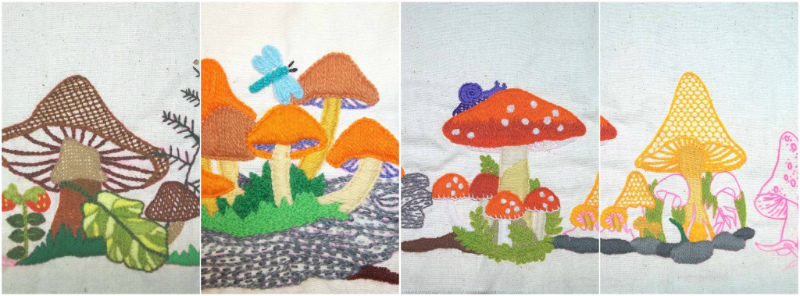
I love the mushrooms! Are they all part of the same project? If so, how big is it and what will it be when it is finished?

I'm so glad you like them! Yes, they are all part of the same piece of embroidery. It is a panel that is approximately 34 inches (87 cm) long and 11 1/2 (29 cm) deep. When work slows down at the end of the year, I will finish it. I haven't decided yet whether it will be framed or become a wall hanging. Either way, you will see pieces of it again on our crewel embroidery posts and a picture of the whole thing when it is finished.

mushroom embroidery collage
Views of the mushroom embroidery, in progress


Am I right that there are some rows of chain-stitch examples on the brown sampler (October 31, 2015 post) that you didn't show in the enlarged samples on blue cloth? Are you going to show us those?

You are correct. The brown sampler was a practice sampler that I did as I was experimenting with new ways to embellish plain chain-stitches. Due to time and space constraints, I left those off of the close-up samples. However, you can see them close-up on the samples below, along with stitching directions.

sampler stitches #1 & #2
Sampler stitches #1 & #2

1) This is just an extension of the #8 stitch pattern on the October 31, 2015, post (laced chain). Starting at one end of the chain (either one will do), lace the chain with a second color of yarn. When the loops are completed, couch each one with a single strand of the same color. Starting at the opposite end of the chain, lace the chain in the reverse direction with a third color. Couch the loops with a single thread in the same color. This makes a very attractive border.

2) Make two parallel chains in the same color. I have made these some distance apart so it is easy to see how the stitches work. You will probably want to place your lines of stitches a little closer together. This is basically a Pekinese stitch (see the January 16, 2015 post) done on two parallel chains. I started at the right-hand end of the bottom chain, but you can start at either end. I drew my contrasting color of yarn through from the back and, working from left to right, made a Pekinese-stitch loop through two adjacent links of the top chain. Keeping my yarn on the surface and working from right to left I pushed my needle down and then up through the next two adjacent links in the bottom chain. No loop this time. I made another loop through the next two links on the top chain. I continued to the ends of the chains. No couching was required. If you begin from the left end of the chain, reverse the left-to-right and right-to-left directions. You may also want to do a sample of an interlaced double chain made the same way as the interlaced double-running stitch shown on the same January post.

sampler stitch #3
Sampler stitch #3

3) Make a rather loose chain with one color of yarn and secure it at both ends. With a thinner yarn of a contrasting color, make a French knot inside each link of the chain. To make a French knot, bring your yarn up through the link, wrap the yarn once around the needle, and push the needle to the back of the fabric, gently pulling it until the knot is formed. Bring your needle up in the next link and continue until all links have knots in them. You may also want to try knots made with floss or metallic thread for more contrast.

I enjoy being able to clarify directions, give additional examples, and expand on topics....so keep those questions coming!


 Creative Commons LicenseThis post by Annake's Garden is licensed under a Creative Commons Attribution-NonCommercial-ShareAlike 3.0 Unported License.

Contact Us

Name

Email *

Message *

Blog Archive