Showing posts with label prints of pencil sketches. Show all posts

Saturday, April 6, 2019

Our New Print Series: Some FAQs

Barred owl print
Barred owl print by Annake
Hi — J.D., Annake’s Garden Gnome here. Annake is feverishly working away on at least three upcoming posts, planning for something special on the coming Earth Day, and grinding away on the final chapters of the first of several e-books we hope to publish later this year. She’s asked me to step in here to give explanations of the whys, hows, and wherefores of what we are doing with the series of prints we have been rolling out for sale. The first draft of this post was much longer than what we try to hold these posts to, so I’ve pared it down to a fairly spare set of FAQ’s.


Why are you suddenly putting all this emphasis on prints?

A number of trends and circumstances came together over the winter: an enthusiastic reception for Annake’s drawings at the late art and crafts shows last year and to their use as gifts over the holidays; a change in emphasis for Annake’s Garden, moving toward a more gallery-oriented business model; Annake’s quest for more and better studio space, and the need to cull decades worth of old notes, projects, clippings and unidentified STUFF out of the way to make room for current projects; the need to upgrade my graphics editing capabilities to meet the increasing technical requirements involved in various projects we’ve taken on; and, last but not least, a very long/cold/wet/gray winter and early spring which limited a lot of activities we usually engage in.

Why are all the prints black and white? Annake’s needlework is so colorful, I was hoping for prints that were, too…

The Rower, watercolor by Annake
Scan of a watercolor by Annake, not ready for printing yet
They are in the works. Our plan is to keep things as simple as possible to begin with — and color reproduction opens a whole new can of worms, so we are going to introduce color to our line slowly and carefully. Differences between types and brands of color printers, the difference between what you see on your computer monitor and what comes out of the printer, even the differences between the way different screens render colors make getting consistent quality a REALLY complicated job.

Annake is hand-tinting some new drawings for our Earth Day post. I’m going to do my best to get good electronic reproductions of those into the shop as soon as possible. Look for a few of my photos, and maybe some of J.J.’s, to show up there in the next few weeks. A lot more color is on the way, but it’s coming on baby steps.

Most of those ‘black and white’ prints we are offering are actually in gray scale, which might make a difference if your printer insists on sucking the color ink cartridges to make grays the way our HP does. I told you it was complicated.  Speaking of the complexity of doing things in color, look for Annake’s first post in her new series on using color in needle arts (and other arts) in May.

leopard print collage
Leopard print in gray scale (left) and true black & white. We prefer the detail in gray scale.


Why so many animals, with just a few prints of people, no landscapes, no still lifes…?

A lot of the reason is just timing — it’s Spring, all the animals are coming out of hibernation, new babies are being born, new life is on peoples' minds — it’s part of our culture this time of year, and reflected in our holidays:   Easter, Arbor Day, even the relatively new addition of Earth Day. We’re just reflecting the calendar. Also, Annake is wrapping up her series of posts on landscapes and seascapes — and those final posts happened to include animals as focal points.  Plus, we have long planned something special for Earth Day (April 22), and endangered animals seems an important issue to address for that post.
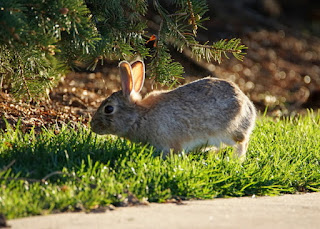
Rabbit photo by jljardine
One of J.J.'s many critter photos
Annake really likes doing animals (she WAS a biology major in college, after all); and my sister, J.J., who has her own addiction to cute furry things, keeps feeding the flames with torrents of emailed photos she has taken; even I have been know to take photos of animals (when I can get them to sit still long enough) so we have lots of raw materials for new posts and projects. It just makes sense to take the editing process for these a few steps further to produce something suitable for sale.

ferret print
Ferret (print of pen-&-ink sketch)
Finally, we already had a lot of nearly camera-ready material to work from. Annake does a lot of preliminary sketching and plotting before she begins major needle arts projects like her “Close Encounter” series or the American wildlife set she has done (and plans more of) on canvas.  She returns to the theme of endangered species often in a number of media. Many of those preliminary drawings don't make the cut for technical reasons like the size, orientation, or materials of the final project. It’s a lot less expensive in materials and time to sort out the problems on paper than fix them halfway through a major needlework piece. If you follow this blog, you have already seen the genesis of the wolf, which became a needlepoint piece last fall, and the black-maned lion, a piece done several years ago that we revised the original plan for and made into a print. The grizzly was a sketch that didn’t quite fit for the bear-and-bumblebee piece we showed you in progress. The ferret to the left was a first sketch for the “Close Encounters” quickpoint we showed in earlier days of this blog. That needlework was one of our first sales on Etsy.

While it sometimes requires Annake to do quite a bit of extra work to make one of these drawings suitable for printing (the lion, for instance, took several days of modifications before she was satisfied with it), it 's still a lot less time and material intensive than creating a new needle artwork. We’ll be adding all the genres you mentioned above (and others) as the seasons move along — but the animals will keep coming back.

Why are you only offering one size of print? Other places online have prints of the same pictures in a variety of sizes…

print in 3 frame sizes
Same print in three frame sizes
This is our first venture into selling print-your-own, downloadable files — we assume there are going to be bugs and glitches, so we are trying to keep things as simple as possible until we are sure the system works the way it is supposed to. Adding more choice of sizes is our first priority after that. The files we are offering will print on 8.5 x 11 inch (U.S. standard document size) paper, so they can easily be trimmed to fit any 8 x 10 inch (U.S.) picture frame, should fit most off-the-shelf commercial mattes for 11 x 14 inch frames, and will even print on A5 (UK standard) paper with a minimum of fiddling — just center the print all around. That is a pretty wide variety of choices to start with.

Why are you using .pdf files? I was expecting JPEGs or some other graphic file format…

Basically, the same answer:  to keep things as simple and predictable as possible while we iron out the wrinkles in the process. PDFs (Portable Document Files) are specifically designed to produce identical results across all platforms, regardless of operating system, hardware differences, or bandwidths; nearly everyone, everywhere has or has access to free PDF reader software; so these files will print the way they are suppose to on just about any home printer and can be handled by any commercial print shop anywhere in the world.

Boy, there sure is a difference between the styles of some of these prints… were they really done by the same artist?

snarling tiger print
Originally done as needlepoint pattern
Yes, they really were: if it has Annake’s signature, it is her original work. Please remember that these were done 1) for a wide variety of purposes: what is appropriate for planning a big needlepoint project is very different from what is useful for teaching a class of 10 year-olds; 2) made over a very broad stretch of time; and, 3) done in a variety of media. Although these versions are all for printing on digital printers, the originals were sometimes in pencil,  marker, charcoal, or pen — often on just whatever was handy at that particular time and place.


Originally done as a demonstration for elementary students, pencil versus  pen & ink

Does this mean Annake is going to stop doing needlework to concentrate on these prints?

pronghorn needlepoint
A new needlepoint, still unframed
Oh, Good Heavens, NO! While some of these drawings were made specifically to turn into prints (mostly to fill out sets and series — Annake prefers to do things in sets), most of them are byproducts of other projects: preliminary sketches, additional illustrations to make a point in articles, examples done for teaching purposes, and sometimes just for fun. Turning them into products to sell is pretty much my responsibility while Annake pursues her next endeavors.


I hope this set of FAQs answers most of your questions about what we are doing, and why — and that you’ll take advantage of this new opportunity to own some of Annake’s original artwork, quickly and inexpensively.

J.D., Annake’s Garden Gnome, sitting in for...


 Creative Commons LicenseThis post by Annake's Garden is licensed under a Creative Commons Attribution-NonCommercial-ShareAlike 3.0 Unported License.

Saturday, January 12, 2019

Fog, Flashing Lights, and Flotsam: Seascapes, Part III

Surf & Rainbow, photo by jljardine
Surf & Rainbow, photo by J.J.
It is foggy this morning. Fog is essentially a cloud that has dropped to ground level. The tiny droplets of water that we feel on our faces as mist are not large or heavy enough to fall as rain, nor are they cold enough to start crystallizing into snowflakes.  Fog is relatively rare in this high, dry country. It is usually welcome because it brings the promise of rain or snow to this drought-damaged region. I can, however, remember a year when fog lingered from mid-December through mid-January,  leaving people short-tempered and depressed. Fog is an emotional thing.

Fog dampens sounds, distorts distances, and interferes with our sense of direction, making it easy to become lost. From an artistic standpoint, it reduces even a complex scene to a few basic shapes. That simplifies the scene and gets rid of a lot of clutter. Only the closest objects and the most distinctive shapes remain. Any source of light or reflection becomes a focal point. On the other hand, fog neutralizes the colors of everything. Fog is gray.

Grey-scale of silhouettes at sunrise
Grey-scale of photo by J.J.
In Part I of this series, we showed J.J.'s photograph of sunrise over the harbor. J.D. has shown it here in gray scale as it might have looked on a foggy morning. Old black-and-white snapshots could also give you more ideas for how things might appear in a light fog.

Much of my artwork lately consists of prints J.D. makes from detailed drawings I've done in graphite, charcoal, and black ink, so I am very interested in grays. I work with them practically every day. We think of grays as mixtures of black and white, but that is a very limited view. Very lively grays can be achieved by mixing complementary colors — the ones directly opposite each other on the color wheel. This technique can give you an array of warm grays, cool grays, soft grays, opaque grays, etc.

simple color wheel
Simple color wheel
It is a good practice to mix complementary colors in needlepoint, particularly in shadows, which always show some of the complementary color of the object which casts the shadow. You might want to make some reference samples of this kind of work. You can do this with separate strands of floss or yarn. The strands can be twisted together or you can use them separately, side by side. Stitch fine lines of the colors close together on small swatches of fabric or canvas that you can keep for future reference. Hold the finished sample at arm's length to see how the blend appears. Keep and use the combinations you like best. Sometimes you may even get an iridescent effect. Orange and blue are complementary colors. Browns are grouped in the orange family of colors. I have gotten nice results with some mixtures of blues and browns. Try a cool greenish blue with a warm reddish brown, for example, or a purplish blue with a yellowish tan.*
Complementary colors from the wheel with mixed grays
Complementary colors from the wheel with their mixed grays

People have been going to sea for thousands of years. Many must have perished in fog, perhaps tragically close to safe harbors. Seacoast cities began building tall towers with large fires burning on top of them to serve as beacons.  The most famous one of these lighthouses was on the island of Pharos by the mouth of the harbor at Alexandria, Egypt. Built by Pharaoh Ptolemy II between 290 and 280 B.C. (BCE),  it was one of the Seven Wonders of the Ancient World.  It survived for more than 16 centuries before it was destroyed by an earthquake. Writers described it as 450 feet (135 meters) tall. Focused by huge polished bronze mirrors, its light could be seen 40 miles (65 km) at sea. There has recently been a magnificent computer reconstruction of it.

A U.S. lighthouse (public domain photo)
Many of these lighthouses were built along the coasts of the United States and some of the Great Lakes to guide ships by their fixed or flashing lights.  Their use has declined since World War II because so many vessels now use SONAR and GPS positioning systems. A few, mostly remotely controlled, are still in use. Others have become converted to tourist attractions, maritime museums, even private homes.  But the lighthouse is still a romantic structure, loved by painters, photographers, and fiction writers. Lighthouses are a popular subject for large photograph calendars. Now that 2019 has already begun, you may find these handsome pictorial calendars on sale for a reduced rate. They are good references for creating your own lighthouse design. Those of you who prefer landscapes to seascapes may be content with the small amount of ocean visible around a lighthouse.

Lighthouse collage by Annake
This picture is one of my collages, now belonging to J.D. Those of you who are quilters can probably imagine stitching a scene like this on top of a patchwork background. It would also be attractive done in trapunto, a type of decorative raised quilting, on a pillow top. In trapunto, two parallel lines are stitched through at least two layers of material to outline the design. Then the bottom layer has slits made in it and stuffing is inserted between the lines. If the lines are quite close together, a heavy cord,  instead of stuffing,  can be worked into the space between the lines.


Watercolor study for a wall hanging
The word flotsam comes to us from maritime law, where it referred to items deliberately dumped into the ocean from ships. Over the years it has come to mean anything that floats on the water. Much of this flotsam eventually washes up on beaches. Most of it is just garbage that needs to be removed in order to keep the beaches clean and safe. It is unsightly; some of it is dangerous. Nevertheless, an attentive person walking on a beach will find something attractive: pretty seashells, branches of coral, deep-sea fishing lures, glass floats, etc. These objects can be put together in collections or made into artistic arrangements.

The picture at the side of this section of the article is a watercolor sketch for a quickpoint wall hanging. It is 23 inches (58 cm) long and 9 inches (23 cm) wide. When the wall hanging is completed, it could be hung either horizontally or vertically.  I think I prefer to hang it vertically, so that is the way I have shown it here. A sketch in progress for a similar composition is shown horizontally, below. I have not chosen a final background color for that composition yet. Those of you who enjoy doing still life designs should enjoy putting together an assortment like one of these. A pattern like one of these, with a wider background, could also be used for a latch-hook rug.
Another watercolor study of flotsam
Think of a foggy day as a fortunate time to spend with a good book (or sketchbook) or to read blog posts like this one.


* Look for more on this subject in our series on using color, coming this spring,

 Creative Commons LicenseThis post by Annake's Garden is licensed under a Creative Commons Attribution-NonCommercial-ShareAlike 3.0 Unported License.

Sunday, December 16, 2018

It Works Both Ways

Colorado Cougar needlepoint
"Colorado Cougar", framed needlepoint
I'm frequently asked about the process I follow in creating my original designs. Actually, there is no single process. Sometimes I have a clear picture in my mind when I begin. (Sometimes the finished project actually looks like that mental picture!)  Sometimes a sketch generates a piece of needlework. Sometimes a piece of needlework generates a detailed drawing or painting.  J.D., who is looking over my shoulder as I write, says: "Well, that ought to confuse everyone. Why don't you show them what you are talking about? I'll download the pictures." Since he keeps photographic records of much of my work in progress, that is what we are going to try to do in this post.

Last Earth Day I told him that I wanted to do a series of works featuring endangered or threatened species, beginning with those in the western United States. I had done two Close Encounters pieces by that time — a black-footed ferret with the endangered Colorado blue butterfly and the grizzly bear with the bee on her nose. I had taken a somewhat whimsical approach to those. Now I wanted to do some more serious  "portraits", more like the black-maned lion that I did in honor of a rare lion and his son, both killed by trophy hunters. I began with a sketch of a wolf. This is not a particular wolf, but rather a composite of several wolves. I noticed in my research that wolves often seem to be smiling or laughing, and that's what the one I was working on wanted to do. (Many artists, if they are honest, will tell you that their work often seems to have a mind of its own; I've found it wise to let mine express themselves.) The result was "Alpha Wolf"'.

original sketch for wolf needlepoint
Original sketch for wolf needlepoint
I began with the sketch you see here. I had already decided to do the "portrait" in French longstitch on a background of tent stitch, so I made a secondary sketch with areas of the longstitch blocked out. I then traced that simpler sketch onto my canvas, keeping the more detailed one for reference.


Blocking diagram for wolf needlepoint
As I stitched the design, the subject continued to express his personality. I always do the eyes of a subject last. Whether I'm doing people or animals, I don't feel that i really know them until we are eye-to-eye. I decided he must be the leader of the pack, proud of his authority and the fact that he would be the father of all the future wolf pups — and happily unaware that he was only alpha male because the alpha female had chosen him.  Here he is.

Alpha Wolf needlepoint
"Alpha Wolf", framed needlepoint

Print of enhanced wolf sketch
As you are probably aware if you read these posts regularly, we have done a number of art and craft shows the past few months. Each one is different. Sometimes J.D. and I spend most of the time discussing his photographs and my needlework with visitors. At other times there are quiet periods when nothing much seems to be happening. Then J.D.  usually goes off with his camera, taking pictures of anything that interests him. I’ve learned to take a sketchbook along. If the lighting permits, which it does not always do, I work on a sketch or two.  At one show I was paging through my sketchbook and came across the early wolf sketch. I had several shades of drawing pencils and charcoal pencils with me, so I decided to do a detailed finished picture from the sketch, knowing J.D. had already photographed the original sketch for future reference. This time my subject had a more serious expression, as you can see in the print which J.D. has made from my sketchbook page.

I had innocently opened a Pandora's box.  J.D. wanted to go through my old sketchbooks and look for other sketches that would be suitable for prints as they were, or with considerable extra work on my part. We showed a few of the prints at a recent event. They were favorably received and the wolf print sold, so I think I have my winter's work already laid out for me. I am getting rid of a lot of paper, which is a good thing, but nothing goes into the wastebasket until J.D. says it goes!

Of the wildlife "portraits" I have completed in the new series of needlepoints, my favorite is the cougar at the top of this post.  I have a great friend of my age group (yes, there are still some of us around and working!) who was doing a painting of a Florida panther — also a cougar — at the same time that I was stitching my Colorado cougar. Neither of us was aware of the other’s project. Hers was done from a clipping she had kept for many years about a female panther which was protected for many years in Florida and became quite a celebrity. I told my friend that hers was a "glamour girl", while mine was a hard-working single mother with mouths to feed.

Detail of cougar's eyes
The cat with Mona Lisa eyes

J. D. discovered when he photographed the finished needlepoint that the cougar's eyes seemed to follow him wherever he went. I had not noticed the effect because I was working so close to her on the canvas. I recalled walking the long gallery in the Louvre, where the Mona Lisa hangs at the center, in both directions and seeing the picture's eyes always following me. So we refer to my cougar as having Mona Lisa eyes. That fascinates viewers, especially children, when we show her.  They walk back and forth to see that it is really true.

After the shows ended, I returned to sketches I made of grizzlies' heads when I was working on "What Kind of Sunflower Are You?" I've made a detailed rendering of a grizzly as a companion piece for the wolf and others. J.D. wants me to let you know that he will have a number of the prints for sale in our Etsy shop (see the sidebar on this post)  early in 2019 for those of you who are interested.

Drawing of grizzly
Print of grizzly bear drawing (Artist's proof)

Let's do what we can to preserve our native wildlife wherever we are.


The Tiger Vanishes original drawing
"The Tiger Vanishes", original pencil/pen & ink drawing

 Creative Commons LicenseThis post by Annake's Garden is licensed under a Creative Commons Attribution-NonCommercial-ShareAlike 3.0 Unported License.

Contact Us

Name

Email *

Message *

Blog Archive