Showing posts with label butterflies. Show all posts

Friday, September 25, 2020

Very Overdue Questions and Answers: Fall, 2020

It has been pretty hectic around here for the past few weeks while we worked on the Extras and on directions for how to use them. That is still our major focus. However, I noticed that the container where I collect written questions and comments, and make notes on verbal ones, was getting very full. It dawned on me that nearly 3/4 of the year has passed and I have only done a single (1!) Question and Answer post! I usually do one every season! So today I am going to try to answer at least the questions about arts and crafts. Some of the questions have been reworded, shortened, or combined. My apologies for the delay.

Do you have any new border designs for cross-stitch? I like to use them on pillowcases and guest towels. I'm pretty much housebound since the pandemic and embroidery sure helps me pass the time.


I know exactly what you mean. Because of my age and some physical problems, I am extremely "high-risk". I have been "sheltered" since January! Fortunately writing, designing, artwork and handwork don't give me much time to dwell on the situation, but I know it can get frustrating and very depressing. There is a new design at the beginning of this article and another later in the post. Enjoy!

How did the sit-on embroidery frame work out? I have been thinking about getting one.

I  was not as happy with mine initially as I thought I would be, but J.D.  did some modifications. He drilled an extra set of holes at the top of the side pieces so that there was another position for the frame. Then he fashioned a padded slip-on cover for the base to make my bony legs more comfortable. I also found out that putting some support — a sturdy flat box will do — under my feet made the position more comfortable. My left hand has improved greatly. It used to cramp painfully from keeping the tension on the needlepoint canvas. One thing I do caution about: you cannot jump up quickly to answer the phone or doorbell.


Did you realize that if you changed one of the two border designs where you did one right-side-up and the same one upside-down (March 19, 2020) that you could put them together and get an owl's face?

Not until you brought it to my attention! That's unusual, because I have owls all over the house and anything about owls rarely escapes my notice. I have some Native American ancestry. One horribly cold New Year's Day when I was a teenager,  a great horned owl perched just outside my bedroom window. We stared at each other off and on all day and I really felt we communicated. From that time on I thought of the owl as my Spirit Animal. J.D. did some of his photographic magic to combine the two images with the necessary change. Is this what you had in mind? I will definitely use the design on a future project!


I love the fish pin with the opal head (June 28, 2020). Where did you get it?

The design was mine. My late husband made the pin. After he retired from the Army, he learned jewelry making and became a successful silversmith and goldsmith. Here is another of his silver pieces that I really love. The gemstone is green turquoise.


Are you going to do another article about crewel stitches in yarn?

I certainly intend to do just that, but probably not until winter. It has been so hot here that it is uncomfortable to even think about yarns! I have a stack of partially finished projects that I work on when we get a cooler morning, but lately those have been few and far between. In the meantime, why don't you take a favorite design or stitch that you have done in yarn and do it again in floss? You get different results and may really like them.  I would encourage all people who do only floss or only yarn to "trade off" occasionally. You may find that it refreshes your interest in crewel or other forms of embroidery. Good luck.

Are you going to do any more animal prints? It seems like it has been a long time since you showed a new one.


I will have to check to see if I have shown all the ones that I have finished. I have a couple in progress, but they are not ready to be made into prints. That is a lengthy process. Right now my studio is pretty cluttered. I need to get materials put away and to sort and file all the things that have accumulated over the past few months. There are lots of those! J. D. is currently working on Extras and catching up on photographic work,  so printmaking is not currently on his agenda either. This is another activity which may best be left until winter. Please keep watching. We will catch up eventually — I hope!


Are you going to do any more of the short features on women artists of the past or the present?

I hope to. I have several lists of both past (some of them so far back that it will surprise you) and the present. The current ones are scattered around the world. I have been featuring them as a part of a question and answer article like this one, but perhaps I need to do a feature article comparing and contrasting some of them. That's something to think about. Thank you for the idea! Here is a portrait by Mary Cassatt, one of the women I plan to feature.

Can you give me an example of a haiku to fit a butterfly outline? They would be done by seventh-graders. (This is from our most recent post on how to use the teaching articles in our Extras.)

We are talking about a couple of different things here. The haiku poems were never meant to be shaped to fit the butterfly outline. Haiku is short and requires a definite arrangement of syllables. I chose to have them put on the butterfly shapes in their traditional form because — like butterflies — they are delicate.

What you may be thinking of is a shaped poem, but not a traditional haiku. You can also make a symmetrical poem which does not rhyme. These are composed of a title word followed by descriptive terms. Notice how the last half of the poem uses words and ideas that are the opposite of the first half. These are a little "tricky' at first, but once the students understand what is going on, they produce some thoughtful and creative results. In the first poem, there is a contrast drawn between the aspen grove, a large place created by Nature, compared with a flower bed, a small place created by a person.


The formal rules for this format are as follows:
  • Lines 1 and 7: a noun for each: the two nouns opposites (antonyms) such as hot/cold, boy/girl, war/peace, etc.
  • Lines 2 and 6: 2 adjectives that describe their respective nouns
  • Lines 3 and 5: 3 participles that describe some aspect of the respective nouns
  • Line 4: 2 words or a two-word phrase referring to the first word, a punctuation mark (semi-colon, colon, or dash), and 2 words or a 2-word phrase referring to the last word.
Haiku is a form of Japanese poetry that has retained its popularity for more than twelve centuries. Traditionally it is a three-line poem with 5 syllables in the first line, 7 in the second, and 5 in the third. The subject has usually dealt with Nature or personal feelings, but modern ones may take up any subject, serious or frivolous. A punctuation  mark or two make a break in the rhythm, usually in the second line, and there are usually two words that underline a strong difference — like "tenderness" and "bramble" in Issa's poem below.

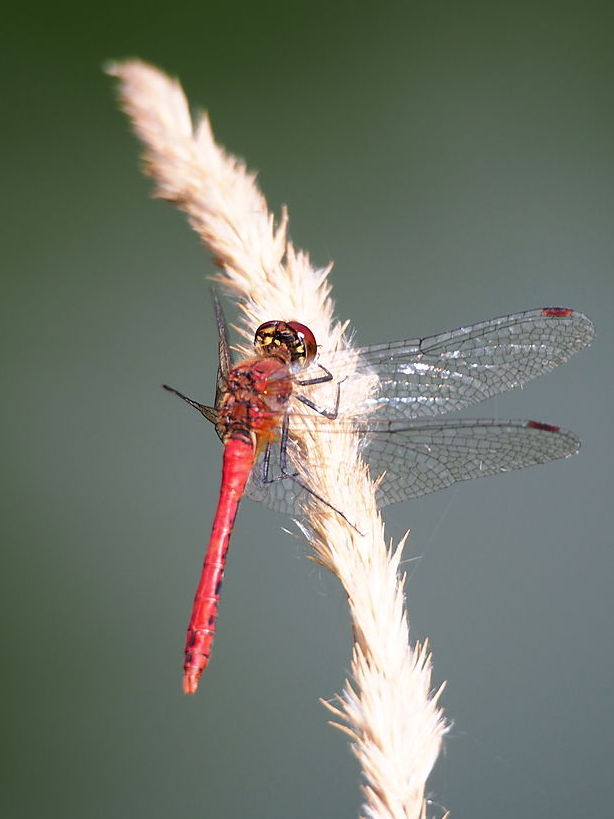
There is a story about the great haiku poet Basho that is one of my favorites. He was walking in the fields with one of his better students when they came across a large group of red dragonflies. Thinking he would show off his wit, the student said to the master, "If we tore the wings off red dragonflies, we would have chili peppers." "No! "exclaimed the master angrily. Humbled, the student asked Basho what he had said that was so wrong. The master said: "Poetry must never be destructive; it must be constructive and uplifting. What you should have said was. 'If we could give wings to chili peppers, they might become dragonflies.' " The student went on to be a popular court poet. But he was never as good as Basho.
 
Here are translated haiku samples from the master, Basho;  my favorite poet, Issa;  and an untranslated one from a rank amateur.
    

    In the twilight rain                       
these breathtaking hibiscus —               
    A lovely sunset.  
                        Matsuo Basho
 
          Everything I
touch with tenderness, alas,
    pricks like a bramble.
                        Kobayashi Issa

     Fingers on keyboard
hesitant; will they produce
     mind-polished verses?
                       Annake

 
Please keep your questions and suggestions coming, even if I don't reply for a while.  They keep me thinking along lines I may have neglected or perhaps  not thought about. I really appreciate them.

Stay safe and well.


 Creative Commons LicenseThis post by Annake's Garden is licensed under a Creative Commons Attribution-NonCommercial-ShareAlike 3.0 Unported License.


Saturday, September 5, 2020

Using Annake's Garden's "Extras"

J. D. and I originally started our "Extras" section (see tab in the menu above) to encourage older people to learn how to keep doing art and crafts even though their eyes and hands, like mine, have lost some clarity and dexterity, and also to encourage newcomers to try new techniques. Then came the pandemic. We found ourselves adding suggestions for dealing with small children, guiding the "’tweens" to learn things at their own pace and look for more, and devising self-teaching units for teens who like to learn on their own or with a group they choose as co-learners. Some of you have already taken advantage of what we have posted and we intend to keep adding to the "Extras" and organizing them to make them readily available.

We realize that there are many of you who will find yourself staying home and supervising children of all ages over the coming weeks and months. This will be new territory for many of you, especially dads, grandpas, and older brothers who may be taking courses of their own. Using our most recent previous post, we are using this current post to demonstrate teaching a topic at many levels, starting with small children. Please bear with us and follow through the age-level examples. You cannot teach a three-year-old the way you coached that after-school soccer team.

If you read our Extras, you probably have noticed that I often suggest teaching children of various ages with simple themes and equipment.  We just did a post about butterflies and moths. That set me to thinking about various things that could be taught to children at various levels of development, starting with teaching very young children with the aid of paper butterflies. The butterflies use simple materials and are easy to make. I have included some outline patterns at the end of this section to get you started. You can begin with very young children and progress to teach more complex ideas as the children grow older. At the end of this discussion I will make some suggestions for older children and also suggest how teens can turn the subject into a self-teaching unit for science, creative writing, etc.


TEACHING WITH PAPER BUTTERFLIES

Prepare yourself:

Make a note of the facts you know about butterflies and do a search for additional information. Children will ask questions — lots and lots of questions. Treat them seriously because they are serious to the children. If you don't know the answer, tell them so and promise to find out. Keep your promise. Breaking promises to children is destructive to your relationship with them. Don't worry that they will think you don't know everything about everything. They will come to that conclusion on their own. And a few years from now, they will conclude that you don't know anything about anything that they are passionate about.

Prepare your materials:

You will need:
    a pencil
    paper (Colored construction paper, gift wrap, colorful magazine  pictures)
    scissors (sharp-pointed for you, put away afterward; blunt-pointed for them)
    tape, paste, or glue
    popsicle or ice cream bar sticks
    patterns for several butterflies
Nice to have:
    a pipe cleaner for each butterfly (cut them in half if you like)
    glitter (Yes, gentlemen, you need to master glitter as well)
    a hole-punch to make holes in the wings or make "dots" to glue on
    clear plastic if you want clear or partially-clear wings

Don't worry. You will need this stuff again and again. Have a place to store it and make participating in clean-up a part of each lesson.

 What to do
:

Click here to download
Cut out two butterfly shapes the same size. For older children, make sure the two shapes are from different papers so that you can demonstrate how the wings look different when the butterflies are flying and when they are at rest.

To make antennae, use two small pieces of paper or bend a pipe cleaner in half. curl the ends of the pipe cleaner so there are no sharp ends.

Decorate the butterfly wings.

If you want wings that are partially clear, cut "windows" in the same place on both sets of wings. Glue clear plastic on the backs of the butterflies.
Cut off any plastic that shows past the edges of the butterflies.

Glue the butterfly bodies to the popsicle stick. You may want to do this one at a time and let them dry completely before you attach the other side. If you are using antennae, glue them to the back of the top butterfly before you attach it to the popsicle stick.

When a butterfly is dry, wave the stick through the air to make sure everything is firmly attached.

Teaching with your butterflies:

Start with simple ideas. Butterflies are very small animals. We should not touch them because we could hurt them. If one comes and sits on us, we should be very quiet and not move until the butterfly flies away. Butterflies fly by flapping their wings.  (Put your hands up, thumbs together and demonstrate flapping. Have the children try to copy you.) When the butterfly needs to rest or sleep, it sits on a plant and holds its wings together. (Hands up, palms together, children copy.) With your paper butterflies, show that the butterflies fronts and backs are different. Let each child choose a butterfly and name it. Let the children "fly" their butterflies around the room for a few minutes, then bring them to be put away. Go through the routine of flapping the next session. Ask the children questions to see if they remember what they learned before. Then teach a couple of new concepts.  It is nice to have a story as follow-up.

If your local library is currently open, find out what children's picture books and storybooks about butterflies and caterpillars are available or can be ordered for you. If you have more than two children, who can sit on either side of you while you read, have them sit in a semicircle in front of you. Show them the cover of the book and then tell them the title. After you read each page, turn it so that all the children can see it and give them time to look. Children will have favorites and want to hear them over and over. Don't show how bored you may be, and don't ‘cheat’ by leaving out parts. They will know! And if you do it again, you will lose a little bit of their trust.

There are literally thousands of pictures of butterflies and short videos about them on line. If it is winter or you are in an area where the children are not likely to see butterflies, these are a good alternative.

You can teach any simple idea with some version of this technique. Don't try to teach too many new things in one day and remember that repetition is the way small children learn. Praise progress; correct gently. Correct quietly, but firmly if the child is doing something dangerous or destructive. You are now officially on your own.  Good luck. There is always the next time to do better.
  
The "’Tweens" —  Grades 4 Through 8

Starting at about 4th grade, children will, if encouraged, begin to find out things on their own. Competition plays a part in this. Timed quizzes and JEOPARDY-type games become popular, especially if grades are not involved. Continuing with our butterfly theme, here are some suggestions for further study, both in and out of class. The work can be individual or group-oriented. The complexity of the questions and the language for the suggested topics can be adjusted to the age level.

1. Butterflies are insects. In the next 5 minutes, write down a list of as many insects as you can think of. (Students make their lists. Teacher writes them on a poster or chalkboard.) Were there any that weren't insects? Cross them off. Ask the students to choose 3 insects from the list and find out 3 unusual or startling facts about them by (give a time limit.) Some students will go much further than the assignment. Share all information.

2. Over millions of years, many flowering plants have formed a partnership with butterflies and other animals. A butterfly visits a flower. It unrolls its long proboscis, a tube-like mouth-part, to drink a sweet, sugary fluid called nectar from the flower. This does not hurt the flower. The flower made the nectar for just this purpose. Often there are lines or spots on the flower to show the butterfly how to find the nectar. While the butterfly moves around, it picks up pollen which sticks to its body. When it flies to another flower, some of the pollen rubs off. This helps the flower.

Research to find the answers to these questions:
    What is pollen and why does the flower need it moved to another flower?
    What kind of light can the butterfly see that we cannot?
    How do flowers make sure that the butterfly picks up some pollen?
    What other animals pollinate flowers? Name one that is not an insect.
    What is cross-pollination and why is it important?

3. Butterflies and moths go through 4 different stages in their lives. They are egg, caterpillar (also called larva), pupa and adult. The process is called metamorphosis, which means "changing shape process". A 4-stage process of change is called complete metamorphosis. Fewer than 4 stages are sometimes called incomplete metamorphosis. For example, a frog goes through 3 stages: egg, tadpole, frog. The caterpillar hatches out of the egg, eats as much as it can, grows so much that it has to shed its skin several times (a process called molting). Then it hangs its body, usually by the tail, on a twig or branch and appears to go to sleep. Its body hardens as a stiff covering forms over it. A moth usually spins a tough silk covering, called a cocoon, for itself and often does this underground. But in either case the body changes completely, so that, when it comes out of the little shell or cocoon it leaves behind, it is a butterfly or a moth. Read about butterfly or moth metamorphosis and draw a picture of the 4 stages.

4. You may want to know why animals and plants have those strange looking scientific names. Think of it this way: the common name "butterfly" is not the same in many other languages — 300 of them to be exact!  Here are just a few of those names for butterfly and their countries: sommerfugl (Denmark), papillion (France), psyche (Greece), chouchou (Japan), farfalla (Italy), lubalaba (West Africa), mariposa (Spain), parpar (Israel). Imagine trying to translate the name of the Tiger Swallowtail butterfly into 300 different languages!  When an animal or plant has one scientific name, scientists from every one of those countries will recognize it and be able to write or talk to scientists in other countries about it. Just for fun, why don't you write a new name for "butterfly" and share it with the class?

5. Teach students the form for writing a haiku. Have them cut a butterfly shape from paper and write or print their haiku on it. Then have them incorporate their butterfly into a poster, paper sculpture, mobile or other art form.  Make a display of all the projects.

6. More ideas:

    Silk thread is made by silkworm moth caterpillars. This is a huge industry. Some older students may want to research it. CAUTION: They may not like what they find.

    The Painted Lady butterfly is found on all the continents except South America and Antarctica. Some students may like the Painted Lady Migration Project. Potential for map studies and figuring large distances.

     Moths have been around for about 200 million years. What do fossils tell us about the Earth at that time? Butterflies appeared about 50 million years ago. What might have been happening to make them become active in daylight?

     Many butterflies and moths are endangered by climate change, deforestation, loss of habitat and loss of food plants. Some may have already become extinct. What can we do to help protect them?

How Teens Can Do a Self-Teaching Unit That They Won't get In School

Teens:  self-teaching units are completely directed by you. There is nothing to be turned in and there are no grades. The units provide information on a subject and suggest activities, but you are in control of which ones you find interesting and challenging. You work at your own speed and select what is most interesting to you. You may work alone or contact friends or fellow students who might like to join you in the study, in person or online. The results of your research can be converted into essays, term papers, speeches, 3-dimensional constructions or other projects if those interest you and further your traditional education.

Currently there are two complete units in our Extras — a botany unit on the history of trees, and one on being an archaeologist. I'm going to "walk you through" a zoology unit suggested by our previous post. There is also a series of our posts on Color, combining several sciences and visual art. Below are the first four in the series, which you can find in our Archives. The fifth installment, which concerns the appearance and development of eyes over millions of years and the impact of color on living organisms today, is slated for late September.

August 14, 2019: Spectral Light And Structural Light; All About Color, Part I
September 24, 2019: Pigments And Palettes; All About Color, Part II
February 10, 2020: The Non-Colors And Metallics; All About Color, Part III
June 28, 2020: The "Escenses" of Color; All about Color, Part VI

In order to make our previous post the basis of a self-teaching unit, first read the directions for the 'Tweens above, and write down investigations that you could carry much further, making note of any scientific terms for follow-up. Then go to the bottom of this page and select "Older Posts". The first one will be our article: "Butterflies, Moths, and Words: Entomology & Etymology". Read it and consider how you would proceed if you chose to study that subject. We will continue to add more units on sciences and the arts as time permits, so check back occasionally. J.D. and I wish you the very best of luck in your studies.


 Creative Commons LicenseThis post by Annake's Garden is licensed under a Creative Commons Attribution-NonCommercial-ShareAlike 3.0 Unported License.

Tuesday, August 18, 2020

Butterflies, Moths, And Words: Entomology & Etymology

Embroidered moth by Annake

We considered just posting this to our Extras section; but, since there is still a little summer left to chase butterflies outdoors, we decided to post it here. Enjoy! — J.D.

About 600 million years ago, plants and animals which had lived successfully in the ocean began to venture onto the pieces of land that had risen above the waves. Some of them were able to adjust to life in small pools and later in lagoons that were a mixture of saltwater and fresh water. Some of the most successful of these animals belonged to the group we now call arthropods (arthro=joint, pod=leg or foot). Arthropods have jointed legs. They don't have warm blood, bones, fins, feathers, or fur. They do have hard coverings called exoskeletons (exo=outer, skeleton=body framework) outside their bodies. Those are the things we can count on. Everything else about them is a case of usually-but-there-may-be-exceptions. Today close to 75 per cent of all the species (a special group) of animals on Earth are arthropods. You didn't think we ran the planet, did you?

Lobsters, border design by Annake
Some of those many arthropods...

Blue butterfly (Public domain photo)
The largest group or phylum (rank) Arthropoda is the class (division) Insecta. Okay, we all know some insects. The largest group or order (arrangement) of insects is Coleoptera (coleo=sheath, ptera=wing), the beetles. The second largest order is Lepidoptera (lepido=scale, ptera=wing), the moths and butterflies. That is a good description because they do have wings covered by tiny scales made from flattened hairs.  The names "butterfly" and "moth" are Old English names for the insects, written about since 700 AD. and later by English authors like Chaucer and Shakespeare. And no, "butterfly" is NOT "flutterby" twisted around. There are at least 160,000 species of moths and 20,000 to possibly as many as 45,000 species of butterflies.

Hummingbird moth, photo by J.J.
When and how did the Lepidoptera separate from the other arthropods? That is a hard question to answer because these creatures are so delicate that they are seldom preserved as fossils. Most of their fossils are of wing scales that left an impression in a material that later fossilized. We can compare them to modern moths and butterflies, but we cannot recreate the original animals. The exceptions are when butterflies or moths were preserved in amber. Amber is fossilized tree sap. When it was fresh, the sap often flowed over insects and other small animals and hardened, preserving them just as they were in life. We do know that the moths came first. There were at least three families of primitive (first or earliest) moths which have been traced to nearly 200 million years ago. If there were three families already at that time, there must have been a common ancestor even earlier which has not yet been found. Butterflies, on the other hand, came along later, 40 to 50 million years ago.

What is the difference between a butterfly and a moth? All butterflies are really moths, but they behave differently. Even then there are exceptions to the 'rules'. Most, but not all, moths are active at night. Most butterflies are active in the daytime. Some of each fly at dusk or dawn. Most moths are relatively small and dull-colored, but we will show you some that are big, boldly colored, and beautiful. Many butterflies are brightly colored and some are large. Moths tend to rest with their wings flat, while most butterflies hold their wings upright and pressed together when they are at rest. Most moths are darker colored on top and lighter underneath, while many butterflies are just the opposite. Both use devices like eye-shaped spots to startle or scare away enemies. Look at the 'eyes' on this Io moth.
Io moth (Public domain photo)
Io moth

Butterfly laying eggs (Public domain photo)
Butterfly laying eggs (circled in red)
All butterflies and moths hatch from eggs laid by the females of their particular species. A female may lay eggs even if she has not mated, but they will not contain caterpillars (old North French word meaning "hairy like a cat"), also called larvae (an immature form of the species which does not resemble the adult). The eggs come in different sizes and in many shapes, including round, oval, teardrop-shaped and drum-shaped. They also come in many colors and surface textures. A female may lay only a few eggs, usually one-at-a-time on the underside of a leaf, or she may lay hundreds. The average number is from 150 to 200. Some females lay their eggs on a specific plant because that is all her babies will eat once they hatch. Others prefer a wide range of plants. The female will die soon after she has laid all her eggs.

Somehow a small generalized form, or several forms together, gave rise to the Lepidoptera. How they did it is not yet understood. The most likely idea goes like this:
    1. In order to get a caterpillar, start with a worm something like an earthworm, but give it strong jaws with small sharp teeth and simple eyes that can tell light from dark. A caterpillar chews with jaws that work from side to side, not bottom to top like ours. Watching one chew is really strange!   
    2.  Divide the worm's body into segments (sections) and stick a leg on each side of every segment. Now you have something like a millipede (milli=1000, pede=leg or foot), which is also an arthropod, except that millipedes have 2 pairs of legs on each segment. They don't have a thousand legs; the record is 750.
Millipede (public domain photo)
Millipede

    3. Maybe that wasn't such a good idea. Let's try this: Make the first 3 pairs of legs the only walking legs and strengthen the segments below them to be flexible and able to wave around in different directions until the legs can find a foothold. Give some of the remaining legs the ability to clasp a surface and keep the animal from falling off a stem or leaf.
    4. Give your caterpillar a color and pattern that helps it hide or a bold, colorful one that advertises "You will be sorry if you eat me!" Many caterpillars are poisonous, having absorbed poisons from the plants they eat, while others just taste nasty.  A bird or frog might eat one, but it wouldn't make that mistake again!

Monarch butterfly caterpillar (public domain photo)
Monarch butterfly caterpillar
When the caterpillar is ready to leave the egg, it chews a hole in the egg's shell and pulls itself out. Many caterpillars then turn around and eat the rest of the eggshell, probably getting needed minerals or enzymes (proteins that speed up a chemical reaction) from it. The caterpillar has a head with jaws and simple eyes. It has six walking legs close behind the head.  It has tiny holes called spiracles ("breathing holes"), on the sides of its segmented body. Toward the rear end of its body it has leg-like structures called pro-legs (pro=before, earlier), which it uses to grip the surface of a leaf. It may be colored to match its leaf, have a textured pattern that hides it, or have a bright-colored pattern that sends a warning. It may look like dirt, a dead leaf, or bird droppings. At least one looks like a snake!

Pupa (public domain photo)
Pupa
The caterpillar's only desire is to eat, eat, eat. It grows fast. While its skin does stretch, there soon comes a time when it must be shed. This is called molting (molt=throw off). The next skin has already formed under the first one. Sometimes, when the outer skin has pulled away, it becomes so transparent that it is possible to see the new one through it. It is soft and damp and can be stretched greatly before it hardens. Not only is the caterpillar now much larger, but its color and pattern may be unlike the previous one. Most caterpillars molt five times over a period of a couple of months. They then stop eating and prepare to move on to the next stage of their lives, the pupa (a name given the structure by the scientist and classifier Linnaeus)  or chrysalis ("golden", from the color of many of them).

The caterpillar finds a secure location in which to make the change. It spins silk threads to fasten itself in place. A butterfly caterpillar usually hangs by its tail, although it may hold itself upright with a band of silk. Over time they have discarded or lost much of the covering that moths use. Moths are more likely to spin tough, papery-looking silk cocoons (French for "sheaths") which may be hidden by dead leaves or the ground itself. The pupa no longer looks like a caterpillar, but does not reveal what its adult form will be.

Luna moth (public domain photo)
Luna moth
Scientists can cut open the coverings of the pupa to see what happens on each day. This kills each pupa, but gives them a look at the "what" of each day's process, and even suggestions about some of the "why" a process is going on, but there are still mysteries concerning the "how". Suppose you were designing a process that would turn a pupa into a butterfly or moth. Here are some of the changes you might make.

Moth antennae (Public domain photo)
Moth antennae
    1. Fuse the first few segments next to the eyes and mouth to make a head. Give it more complicated compound eyes with excellent vision even into colors and wavelengths of light that we cannot see, including polarized light.    
    2 Get rid of the jaws and teeth and substitute a flexible mouth-part that can be rolled into a tube for sucking nectar or other juices from a plant and can be rolled up neatly below the head when it isn't in use. Stick on a pair of sense organs known as antennae (old sailor's term for a "sail yard", the long structure that supports a sail) or "feelers" at the top of the head. The term "feeler" is misleading. These organs carry the animal's sense of smell. Only the males have the super-large feathery antennae seen here. They're sniffing for females.
Emerging butterfly (public domain photo)
Emerging butterfly
    3. Fuse the next three segments and put a pair of jointed legs on each one. These are the same legs the caterpillar had, just rebuilt. If a leg is damaged in the caterpillar stage, the butterfly or moth will be lame when it emerges as an adult.
    4. Expand and harden the next section to make a thorax (chest). Make this part of the body anchor the 3 pairs of jointed legs and the powerful muscles that move the wings. There are 4 wings. The pair of wings up by the head are called the forewings. The pair farther down are the hindwings. Poke some holes for the spiracles so that air can move in and out.
    5. Stretch the last part of the body to make the abdomen (belly). This should have about 10 segments and contain a long tubular heart, muscles for breathing, the digestive system, the reproductive organs, and an ovipositor (ovi=egg, positor=placer) for the female. This is a tube through which she can lay her eggs. That should do the job!

Butterflu antennae (public domain photo)
Butterfly antennae
The change from the pupa to the adult is a process called metamorphosis (transformation}. The adult breaks out headfirst. Most butterflies have thready antennae with little knobs on the ends. Moths have heavier antennae, usually without knobs, and larger scales on their wings. They usually have thicker bodies with coverings of hairs or what looks like fur — probably to keep them warm at night.  You should discover fairly soon whether the adult is a butterfly or a moth.

One difference which isn't visible is that many moths have hearing organs (not "ears") on or inside their bodies. Moths and bats have been having an "arms race" for millions of years. The bats develop better ways to find the moths and the moths develop better ways to confuse the bats. Some moths actually make clicking noises that interfere with bats' 'radar'. But moths had some of these organs before there were any bats. Scientists have found that some male moths make sounds to attract the females.

Cecropia moth (public domain photo)
Cecropia moth

When I was a teenager, I used to collect cocoons every autumn. My room was the coldest place in the house, so I pinned the cocoons to the curtains in the north window. In the spring I was rewarded with the appearance of big silk moths like this one. They never failed to hatch. Most were females. The males just dry off and fly away. The females linger, giving off a musky perfume that many people don't like, but I enjoyed. They wait patiently until the males, lured by their scent from as much as a mile away, come calling. The ladies each chose their favorite and flew off to mate and start the life cycle all over again.

Polyphemus moth (public domain photo)
Polyphemus moth

Moths have had many millions of years to adapt to all kinds of conditions and can be found all over the world except in the polar regions. They are not a problem in themselves, but some of their caterpillars have become serious pests because they eat clothing, food crops, and other things that we value. On the other hand, they produce silk and pollinate a number of plants. They pick up pollen while they are feeding on one flower; some of it rubs of inside the next flower. Even butterflies, although they are great pollinators, can have harmful caterpillars. A good example is the white cabbage butterfly.

Monarch butterflies (public domain photo)
 Migrating Monarch butterflies
Many butterflies have a relatively small range, usually tied to their choice of a food plant. Others, like the Monarch, migrate seasonally and return to "home base" for the winter. But one little butterfly has already established itself on all the continents but South America and Antarctica. (They are established in Central America and tend to stay in the mountains in hot countries, so we may find them there in South America soon.) Its name is the Painted Lady. It has divided into a number of species over time and distance, but none exceed the 2-21/2-inch size range, All have the same color combination and similar patterns. We have 2 species: the American Painted Lady and a slightly larger species that was probably its ancestor, which visits from Mexico every year. Their range has expanded northward until it is now well north of the Canadian border. The butterflies have been collected by the thousands over the centuries and preserved in collections, but look at any one of them and you will recognize a Painted Lady.  Scientists now believe that this species may be the first to solve the problem of flying long distances and set out from Africa thousands of years ago in its quest to conquer the world.

Painted Lady butterfly (public domain photo)
Painted Lady butterfly

I could never bring myself to kill butterflies and moths, stick pins through their dead bodies, and store them in a box. I learned so much more from them alive. I'm glad that I didn't kill them. Because of global warming, plastics, deforestation, spraying with insecticides, etc., many species may already be extinct and thousands of others are threatened. They need our help now.

The study of insects is called entomology. The study of word origins and meaning is called etymology. I hope you have enjoyed the examples I included.

Now I have a personal message. Humanity is a single species. No segment of it is superior or inferior to any other. Humans, in all their infinite variety, should be accepted and appreciated.


 Creative Commons LicenseThis post by Annake's Garden is licensed under a Creative Commons Attribution-NonCommercial-ShareAlike 3.0 Unported License.

Contact Us

Name

Email *

Message *

Blog Archive