Showing posts with label skyscapes. Show all posts

Thursday, July 11, 2019

The Moon, Lightning, and Other Special Effects: Skyscapes Part 3

moonlight on dunes by J.D.
"Moonlight on Dunes", digital art by J.D.
The full moon is a welcome sight for most of us, despite its ancient reputation for bringing out werewolves, madmen, and other odd phenomena. Certainly this year has given us some interesting full moons. If you are a moon watcher, you know that the moon has phases. Many calendars show those phases. sometimes we don't see the moon at all. This is the "dark of the moon", shown as a black circle on the calendar and called "New moon". The changes to the moon take place on its right side.  First a thin line of light appears along that side, gradually becoming a bright crescent, while the rest of the moon remains dark. This is sometimes called "first crescent". The crescent continues to grow, a process called a waxing moon.  You may have seen pictures in children's books that show a crescent moon with a man's face drawn inside the curve of the crescent. J.J. happened to catch the moon at a time that may explain why people have seen this particular appearance of the "Man in the Moon". 

crescent moon line art (public domain) and photo by J.J.
Crescent moon
More and more of the moon's surface becomes revealed, until we see a half moon.  Craters and other features of the moon's surface become prominent. By the time the side of the moon facing us is displayed as a full moon, the markings on the moon's surface are even more distinct, leading to a new version of the "Man in the Moon".

Full moon graphic and photo (public domain)
Full moon
Half moon, photo by J,D,
But the full moon doesn't last long.  Darkness begins to cover the moon's surface, again from the right.  Soon there is just another crescent, facing the opposite direction. This is sometimes called "last crescent". The darkening process is called a waning moon. (The terms "waxing" and "waning" are important if you hope to photograph the moon. To see the moon in conjunction with sunrise or during the early morning, it is best done when the moon is waxing. A waning moon sometimes produces a vision of the moon in late afternoon or at sunset.)  J.D. captured this one in late afternoon. Eventually the moon disappears into darkness again.

The best time to photograph the moon is during the "blue hours"  before dawn and after sunset. Get to your spot — well away from the reflections from city lights — early in both cases. As you wait for the sun to go down, you may catch the moon and sun in the same photograph. If you are patient in the early morning, you may get the moon and the rising sun in the same exposure.

Ring around the moon, photo by J.J.


Here is a picture J.J. got of a ring around the moon.


Moonlight, especially from a full moon, is more powerful than you might imagine. We had one full moon this spring that was almost bright enough to read by. To get a good photograph, stand with your back to the moon and allow your eyes to adjust to the light. Make the most of features that are in varying degrees of shadow. Use a tripod to keep the camera steady and a remote shutter release. Bracket your shots with both longer and shorter exposures to get the most interesting effects.

Moonlight in the Garden, photo by J.J.

Lightning, public domain photo
Lightning is extremely dramatic, but also extremely dangerous.  If you are going to attempt pictures like these, be sure you are well-protected. And it isn't necessary to have a close encounter with lightning to see it in its many forms. It hardly ever just forms a zigzag like the ones you see in cartoons or on logos. If you are thinking about adding lightning to a picture you are making or a logo you are designing, I suggest checking first with the National Weather Service online. They have good photos and often videos of storms. Then check public domain photos of lightning. There are literally hundreds of them out there! Lightning is most dramatic when it has many branches, when it does unexpected things, and when it illuminates an interesting object or scene on the ground.

If you live at the right latitudes to see either the Aurora Borealis or the Aurora Australis — or plan to travel to these regions — you can be treated to some outstanding sky displays. The luminous curtains, swirls, and bands are caused by atoms in the atmosphere that have been excited by emissions of electrons along the planet's magnetic field lines. Since the North Magnetic Pole is rapidly changing position at this time, this may be a very good year for auroras.  I suggest using a large clipboard or lap-desk with a clamp-on high-intensity battery-powered light,  and dark-colored construction paper and chalk pastels to capture images of the lights. The sides of the chalk can capture the movement of the "curtains" of light, while the points can put in finer details. I know I talk a lot about sketching, but the details of images fade quickly and are best caught in a form that will later stimulate memories.  Put in some sort of detail in the low foreground — mountains, trees, a city profile, etc. — to show the vastness of the display. A lighted tent, tepee, or igloo can be a nice touch.  And finger-less gloves are a hand-saver.

Aurora sketches by Annake
Man-made displays can also be interesting. Here are a couple of photos of fireworks. See what a difference shutter speed can make!

Fireworks, photos by J.J., center photo public domain
Fireworks!


Geese in flight (public domain photo)
There are many reasons to watch the sky for interesting occurrences. We have both bald eagles and golden eagles in our area and can often see them riding thermal up-drafts. There are ospreys on some of the larger lakes on Grand Mesa, where it is possible to watch them fishing, nest-building, and raising their families. We are fortunate to be underneath the flyway for migrating sandhill cranes and to have one of their regular rest-stops during migration within easy driving distance. Ducks and geese follow similar migratory pathways.

There is no shortage of man-made objects flying through the skies as well: airplanes, seaplanes, helicopters, crop-dusters, fire-fighting equipment, etc. There are scientific devices like weather balloons. There are also recreational vehicles like gliders, para-sails, hang-gliders, parachutes, zip-lines and drones. Any of these has the potential for making an interesting or exciting picture.

Montage of man-made objects in the sky (public domain photos)
Things you might see if you look up...


Hot air balloons (public domain photo)
Here is a colorful photo of hot-air balloons just beginning to rise into the air.


So I encourage you to keep your eyes on the skies. You never know when you will be in just the right place at just the right time.

Baby elephant in the clouds, photo by J.J.
This is the last in our series on Skyscapes. We hope you have enjoyed them and have even gotten some useful ideas from them. If you have ideas for future articles like these, please let us know and we will try to oblige. You can reach us at:

annakes_garden@yahoo.com or annakesgnome@gmail.com

Have a wonderful summer.


All photos public domain unless otherwise credited.

 Creative Commons LicenseThis post by Annake's Garden is licensed under a Creative Commons Attribution-NonCommercial-ShareAlike 3.0 Unported License.

Sunday, June 2, 2019

Sunrises, Sunsets, and Rainbows: Skyscapes, Part 2

Watercolor sketch of sunrise
Watercolor and pencil sketch of  a sunrise by Annake

Sunrises are rewards for those of us who rise in the dark, eager to see what the day will bring. Because you have only about 20 minutes, start to finish, to capture a sunrise or sunset, it is probably best to work from a series of photographs taken at short intervals.  If you are sketching, I find it best to get the shaded areas done with their proper weights (values) and to write the names of specific colors or color combinations in the appropriate areas, to be filled in later. If you are going to try to capture the colors, believe it or not, a large box of children's' crayons may be your best tools. You can outline the major areas with pencil and scribble in enough color to match and blend together when you work on an advanced version of your sketch.

Sunrise on the shore, photo by J.J.
Sunrise at the Shore, photo by J.J.


Here is a simple sunrise scene that could have been taken almost anywhere. You may want to time yourself to see how quickly you can sketch it in crayon, pencil, or pastels.


Stormy sunrise photo by J.J.
Often our sunrises are paler and less intense than our sunsets, but once in a while we get a vivid, blood-red sunrise that brings to mind the old rhyme: "Red sky at morning, sailors take warning; red sky at night, sailors' delight." Sunrises often defy the ‘rule’ that clouds are always darker on the bottom. Because the source of light is below the horizon and is growing more intense by the moment, clouds are sometimes brighter at the bottom than they are at the top.

Sunrise on the lake, photo by J.J.
Sunrise on the Lake
Even after the sun has cleared the horizon, you have a short period of time to capture and record its effect on both the lower and the upper sky. Do NOT look directly at the sun at any time while you are doing this.  Choose your center of interest beforehand so that you can get the emphasis you want in your photograph or quick sketch. Give your center of interest the detail and prominence it deserves. This photograph shows a scene soon after the sunrise has faded.

Sunrise with deer
Sunrise with deer, from Annake's sketchbook
One morning I was describing a sunrise in my journal as the colors changed. Suddenly I realized that I was not alone. A doe, last-year's fawn, was standing at the curb, staring intently at the same patch of sky that I was watching. The colors had faded to a pale saffron and a range of blues  Abruptly a thin arc of brilliant white appeared above the mesa. Within a few minutes it would be a great glowing disk, too bright to look at. Satisfied that our world was working properly, the doe and I turned away — she to munch on our infant lawn and I to write my impressions, make a simple sketch — and put her in it.

Rainbow, public domain photo
Rainbow
If you didn't know what causes a rainbow, you might easily feel that it was something magical and make up a story to explain it. People around the world made up myths and legends to explain rainbows. The most common one was that the rainbow is a bridge between Heaven and Earth, used by gods, their messengers, the ancestors of of the world's peoples, and/or for kings, pharaohs, heroes who died in battle, or people who ad lived exemplary lives to get to Heaven. Another idea was that the rainbow was actually a bow, usually in the hand of the god of thunder, to shoot arrows of lightning at the Earth.


A rainbow occurs when a thin layer of water droplets appears opposite the sun. This is usually just after a rainstorm passes by. Sunlight is made up of many wavelengths of colored light. As the rays of light are absorbed by the water drops, which are denser than the air, the light slows down and is bent at an angle. When the light leaves the water droplet, re-entering the air, it is bent again and speeds up. The bending of the light causes it to separate into its color components. When this happens in a collection of droplets, the result is a rainbow.

Double rainbow rhoto by J.J.
Double rainbow photo by J.J.
A rainbow is actually a complete circle, not just an arc. The entire circle can sometimes be seen and photographed from an airplane flying at fairly low altitudes. From the ground we only see an arc. So, sorry, there is no "end of the rainbow" — with or without a pot of gold. In order to see the rainbow, you need to have the sun behind you and no clouds nearby on the other side of the rainbow. The longest wavelengths of light are red; the shortest, violet. The red rays are bent the most and appear at the top and sides of the first layer of the rainbow. The violet rays are bent the least and appear at the bottom of the inside of the rainbow's arch. In between the two are the wavelengths of orange, yellow, green and blue. Occasionally there is a double rainbow. The second one is much fainter than the first and the colors are seen in the reverse order (violet on top, red on the bottom).

Rainbow sketch from Annake's sketchbook
From Annake's sketchbook
When you want to capture a rainbow on paper, you will have to be even quicker than when sketching sunrises. I recommend this order: first, place the curve of the rainbow and its position on your sketch; then rough in the rainbow’s colors. Next, suggest the color of the sky surrounding the rainbow. Leave any foreground objects for last — they will be there long after the rainbow has faded and the sky clears. Remember that this is a sketch, meant to aid your memory, not a finished work — try to catch the elements of what made the scene memorable in the first place.


Sunset photo by J.J.
Sunset colors are often so brilliant that they seem unreal. Tropical sunsets can be especially vivid, You may want to lighten such colors in your composition and show the effect of the colors on objects in the foreground in order to make them seem more realistic. On the other hand, if you prefer the very brilliant colors anything in the foreground should be limited to strong silhouetted forms with very little color detail. Of course there are gradations between the two techniques, depending on the angle between the foreground and the sunset sky.

Winter sunset photo by J.J.
If you are taking photographs, I suggest you turn around and and  capture the sky in the east, directly opposite the sunset. You may find it better suits your purpose. The objects in the foreground are well-lit and not silhouetted. You can replicate the sunset sky in pastel colors and still show colors reflected on objects on the ground. This photograph shows the effect of light from a winter sunset on the ground in front of it. The sun is very low in the sky.


If you have the time to do so, take photographs or make quick sketches of the sunset scene on three or four consecutive days. Skies are seldom the same. Be sure you are positioned in the same spot each time. You should see quite a few differences, depending on the atmospheric conditions, which affect the quality of the light, and the time of year, which dictates the angle at which sunlight strikes the earth. Compare the scenes. Chose the ones you prefer and file or discard the others. Make at least one finished composition based on your choices. Combine elements from the different scenes if you like.

Panoramic sunset photo by J.J.

After the sunset you have a period of 20 to 30 minutes — depending on the terrain, weather, and time of year — to capture the lingering colors and their effects on the objects silhouetted. It is probably best if you don't begin until the sun has completely dropped below the horizon. Work with the reflection of the sun's colors on the clouds in the sky and what happens as they change. After-sunset skies are usually much more vivid than before-sunrise skies, particularly if there are thin clouds in the scene. Dust particles and smoke also produce rich reds and oranges. Notice the foreground as it darkens and gives you back-lit silhouettes. And don't forget to look over your shoulder to see what is happening in the east.

Watercolor sunset by Annake
Even if you don't photograph, draw, paint or embroider these beautiful aspects of Earth's technicolor light, please do pause to enjoy them.


 Creative Commons LicenseThis post by Annake's Garden is licensed under a Creative Commons Attribution-NonCommercial-ShareAlike 3.0 Unported License.

Sunday, April 28, 2019

Blue Skies and Cloudy Skies: Skyscapes Part I

Colorado landscape photo by jljardine
Colorado landscape photo by J.J.
Why is the sky blue? It is because of the atmosphere. If we were astronauts standing on a planet that had little or no atmosphere, we would be looking up through the face-plates of our helmets at the blackness of outer space. Instead, we are looking at that blackness through a deep layer of atmosphere. If we look sideways toward the horizon, we are looking through even more atmosphere — complete with dust, smoke, industrial haze, etc. By the time you look at the horizon, you may find that the sky has lost most of its blue and has taken on a yellowish tinge. This is most noticeable in the winter. The blue color of the sky is produced by the reflection, refraction, and scattering of light by particles and water droplets in the atmosphere. I have looked at skies on three different continents and have seen a large variety of blues. One factor in the blue of our Colorado skies is that much of the state is a mile or more above sea level. That means there is a mile less atmosphere between us and the edge of outer space.

Sky reflected in a pond, photo by jljardine
Sky reflected in a pond, photo by J.J.
We talk about "clear blue sky" but it is not a uniform blue and it is a mistake to portray it that way. If you are simply using the sky as a background for your subject, you should still make your sky realistic Otherwise, your picture will lack depth and naturalism. The darkest blue is directly overhead and grows lighter closer to the ground. It is not enough to simply lighten the blue you used for the top of the sky.. There are different blues in the sky and you will need more than one to show it realistically — as in the picture to the right. Look at the reflection of the sky in the pond. You can see the deeper blue of the sky overhead, which is not visible in the photograph itself. Such details make a composition come to life.

original of "Racing the Dragon," photo by jljardine
Uncropped original of "Racing the Sky Dragon," photo by J.J.

You can also see this gradual change in this photograph, even though it is interrupted by clouds. You can also see that the clouds are darker on the bottom and brightest at the top. If clouds are very close to the ground, they may pick up earth tones in their bottom shadows. Notice that the clouds disappear below the ridge. You cannot see the horizon in this picture. What you see is the horizon line, which is the ridge the solitary cyclist is riding along. If your composition is primarily about the clouds, you should still put in a strip of land or sea at the bottom of the picture to emphasize the vastness of the sky. The ridge and rider do this well.

Old cabin photo by jljardine
Old cabin photo by J.J.
If the subject of your picture is in the foreground, however, make the sky and clouds simple and unobtrusive, without sharp edges. They should be light in color if they are contrasted with a darker, very detailed subject like this building.  If the foreground is brightly illuminated, on the other hand, you may want to deepen the sky colors and make the edges of the clouds, as well as the shadows at their bottoms, more distinct. Try to find a pleasing balance between foreground and background.

Skyscape photo by jljardine
Skyscape photo by J.J.
What are clouds and how do they form? Water evaporates from the surfaces of earth and sea and rises in the air in the form of vapor. Eventually the cooling vapor begins to condense into tiny droplets. This area is called a "ceiling' or a "condensation layer". It is here that the water droplets become visible to us as clouds. Clouds move and change shape, driven by the wind. The shapes are quite varied. If you want to use clouds in your compositions, you may want to make a collection of photographs and/or sketches of clouds for reference. There are many classifications of clouds. I will deal with the three most generalized ones.

Downloadable cumulus cloud background by Annake
Click here to download
These are cumulus clouds. they are most common in the summer. They are generally rounded at the top, thick, and fluffy, often piling high into the sky. They are sometimes called "fair-weather clouds", and are used in many depictions of summer scenes. This sketch is downloadable. You can use it as a background to practice your own compositions.

Clearing skies watercolor by Annake

On the other hand, cumulus clouds also form the basis for the storm clouds we call "thunderheads". Driven by strong winds, the tops — while still rounded — are more broken and the edges are less distinct. Dark gray clouds may show through the irregular edges, as well as through breaks in the clouds themselves. The column of clouds towers over the land, dimming the light below it and casting shadows on the land. The shadows at the bottoms of the clouds are a darker gray — often showing an ominous green or purple cast. Features on the ground are darker and less distinct, and may be obscured by light gray streaks of falling rain. As the storm departs, the columns of clouds break up and the sky clears from the horizon upwards.

Cirrus clouds, photo by jljardine
Cirrus clouds, photo by J.J.
Cirrus clouds are less common than cumulus clouds because they form from ice crystals at very high altitudes. Sometimes they form an anvil-shaped cloud. More often they are blown by the wind into thin wispy or scarf-like layers at different elevations. They often move in different directions and at different angles.  J.J.'s photograph shows this type of pattern. She even captured the reflection of the cloud pattern on the water. The clouds form interesting patterns, but the patterns change very quickly, so they are difficult to capture. These are probably the most difficult of the kinds of clouds to portray, but they can be spectacular, particularly when they are back-lit by a rising or setting sun. Cirrus clouds in a clear blue sky almost guarantee a beautiful day. But don't get too relaxed. They signal a change in the weather usually within 12 to 24 hours — and that change is not generally for the better. If you can determine the place where the clouds originate, you will know what direction the changed weather is coming from.

Stratus clouds watercolor by Annake
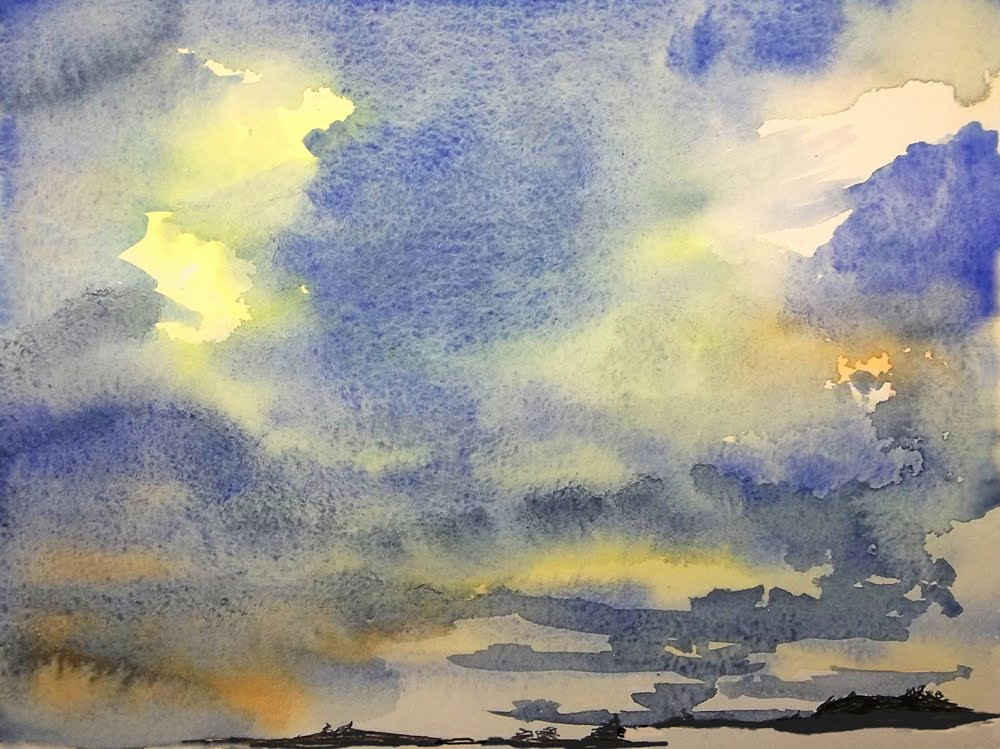
The third type of cloud is a Stratus cloud. These clouds form layers at different elevations. They are formless layers of cloud with fuzzy edges. They are very slow-moving and often hover over a region for hours and even days. They look very dense, but sunlight or moonlight can sometimes shine through them or reflect off them, as you can see in the upper layers here. They are not serious storm clouds, although they may produce a drizzle or light snow. This is a picture of stratus clouds that I painted in watercolor. Their slow movement gave me time to capture the entire scene. I tend to paint what I see, even if my picture breaks some of the "rules", so you can believe that this scene was as accurate as I could make it without a camera.

If you are not already a sky-watcher, try to become one. Skies are usually most interesting in the early morning and the late evening, but unusual cloud formations can appear at any time. When you see one, try to photograph it, make a simple sketch of it, or jot down a description of it in quick phrases. Once you have collected a few, think in terms of how you could use them in simple designs or compositions. Just remember that skies with clouds are usually more interesting than those without them.

Troubled sky, photo by jljardine
Troubled sky, photo by J.J.

Happy skies,    


 Creative Commons LicenseThis post by Annake's Garden is licensed under a Creative Commons Attribution-NonCommercial-ShareAlike 3.0 Unported License.

Contact Us

Name

Email *

Message *

Blog Archive