Showing posts with label crocus. Show all posts

Monday, April 13, 2015

Persevering Plants

Resilient Crocus
"Resilience"
This is the time of year when I fold my needlework, put away my art and craft supplies, and become a servant of the plants. J.D. keeps his camera handy, but deserts his computer to rake and hoe, plant and cultivate, water and weed. Most of our daylight hours are spent in the greenhouse or the various garden plots tending vegetables and fruits for our stomachs and flowers for our spirits.

Violets
Violets
I have always surrounded myself with plants. As a child on the farm, I used to take my little red wagon and follow the men as they cleared the roadside ditches. I would fill the wagon with clumps of wildflowers, take them home, and plant them around our house. At one time I had eight kinds of wild violets. I have one kind here. It planted itself in one of the garden spots last year and has now established several “colonies”, including one on bare rocks. I admire its tenacity, perseverance, and determination to grow and thrive.

Our eighty-seven-year-old next-door neighbor has an apricot tree that is more than one hundred years old. Despite its age, in good years it bears hundreds of firm, luscious fruit. The few branches that hang over our yard provide all the apricots we eat during the summer, plus plenty to freeze for winter. We had two mild freezes in March, while the tree was in bloom, so we must wait weeks to find out if there will be an apricot crop this year.

Crabapple Blooms
Crabapple Blooms
In our front yard is a crab apple tree that has been my favorite tree for more than thirty-five years and it was old when we moved here. I don't make jelly from the fruit any more because it requires too much sugar; I leave the fruit for the birds to enjoy. A small flock of cedar waxwings stays with us for a day or two in the fall, eating the fruit to fuel their bodies for migration.

We feed the birds all year long and maintain several birdbaths. Soon after we moved here, I noticed plants growing here that had not been here when we arrived and that I had not planted. I realized that at least some of them had probably been introduced by the birds. Many were annuals that bloomed for a season and disappeared, but some became permanent residents. The most spectacular of these is an Oregon holly-grape. It started as a tiny seedling beside our homemade greenhouse. I liked its glossy, spiny foliage and watered it from time to time. Today we have a dense cluster of plants that reach to my shoulder and are about eight feet (2.5 meters) in diameter. They are spectacular in the spring when they are covered with spikes of vivid yellow flowers. In the fall their berries supply food for birds and other animals.

Oregon Grape Holly
Oregon Grape Holly

The evergreen tree beside the holly-grape was also a surprise. It suffered a lot of damage from the deer the first couple of years. As its prickly companion grew behind it, however, the deer lost interest in it. It is taller than I am now and has regained its symmetry. It grows more attractive each year. I really approve of the birds' landscaping efforts!

Rhubarb
Rhubarb, bent on world domination
Not all our prodigious plants have been so welcome. We had a rhubarb patch that grew much more than we could eat, preserve, or even give away. My husband would dig it up, but it would come back the next year. At that time we had a small boat that we used for fishing. One autumn, he overturned the boat on the rhubarb, sure that it would die over the winter. The next spring I noticed that the boat appeared to be several inches above the ground. Removing the boat revealed a healthy boat-shaped rhubarb patch that had raised the boat with stems and leaves. Then he had a load of crushed rock dumped on the plants. I was afraid he had finally succeeded. As you can see, he had not. As J. D. uses the rock for landscaping, I expect that patch to grow and grow and grow.

Forsythia
Forsythia "tree"
Some of our plants have delusions of grandeur. Our forsythia and snowball bushes are fast becoming small trees instead of shrubs. They appear to be having a contest to see which one can grow tallest. Currently the snowball is in front. The remarkable thing is that they can do this in our arid climate without requiring additional watering.


Coral Rose
Coral Rose
Then there is our most ambitious rose. It is a climber that produces lovely coral blossoms. It is often the first of our roses to bloom and always the last one to stop blooming, producing blooms even through three frosts last autumn. It long ago outgrew its trellis and now supports itself on the greenhouse. It doesn't seem to need much support, however, since it now grows a good four feet (125 cm) above the greenhouse roof.


Lenten Rose
Lenten rose, making a home under the mock orange
We planted a mock orange bush at the end of a nice lilac hedge. Everyone said it wouldn't survive our cold winters. Not only does it perfume the neighborhood every May, but it has grown over, under, and through the lilac hedge (which is now taller than the house) for more than the length of the entire house. Then it “jumped over” a large garden plot and, perhaps with some help from the birds, grew another large bush against the side of a storage shed.

So, whenever you get the opportunity, stop and smell the violets and the mock orange and the roses. And, like the plants,

Strive to thrive!


Red and white tulips
Early tulips celebrate the arrival of warmer weather


 Creative Commons LicenseThis post by Annake's Garden is licensed under a Creative Commons Attribution-NonCommercial-ShareAlike 3.0 Unported License.

Wednesday, April 3, 2013

Resilience

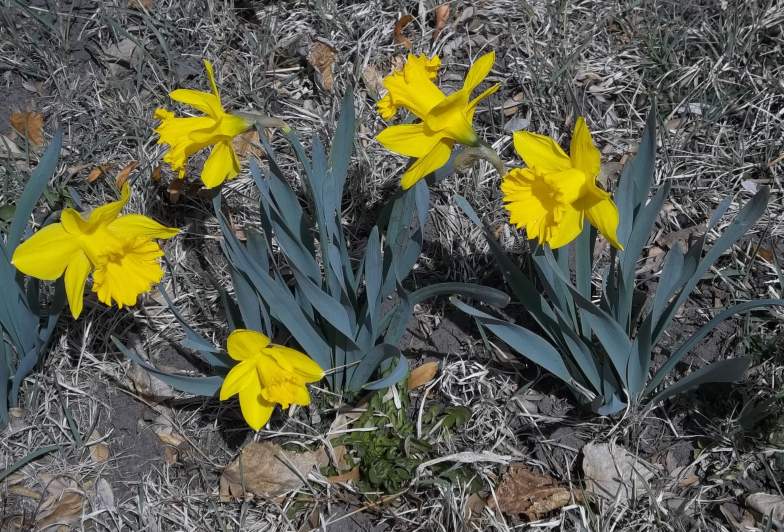
The garden has awakened. Shyly at first, like sleepy children, the crocuses appeared. Soon they were joined by graceful white snowdrops and miniature irises in their passionate blues and purples. Now there are clumps of bells-of-Holland and star-flowers. Jaunty daffodils flutter in the breeze. By mid-week we will have fragrant hyacinths in a rainbow of colors.

Daffodils.jpg
The Year's First Daffodils
One of my teen-aged garden helpers once observed how wonderful it was that the garden starts subtly and close to the ground in spring, grows taller and showier to culminate in the giant sunflowers of late summer, then begins to recede toward the earth again in autumn. Our garden both begins and ends with crocuses. Before they disappear below ground for another year, the leafless autumn crocuses warn us that winter is on its way and we must get busy to prepare for it.

Our plants must be resilient. They emerge to face a prolonged drought, extremes of temperature, drying winds, and other problems presented by high altitude. We are close to 6,500 feet above sea level here. Thunderstorms, even thunder-snows, are common. Frosts and freezes strike at inopportune times. I'm afraid the century-old apricot tree that overhangs our back fence has already lost its crop to recent bitterly cold nights.

Making jewelry.jpg
People, too, must be resilient. I'm proud to say that resilience is a characteristic of our group of artisans. None of us are young. We range from middle-aged to nearly eighty years of age. Recent years have not been kind. About half of us have faced the adjustment to retirement from long careers. A couple of us have been widowed. Others have faced serious illnesses or injuries, or are caretakers for ones who have done so. Economic woes have cost jobs, lost savings, and relationships.

Sue working.jpg
Still, we are a hardy, resilient group. One of the things that has supported us through hardships is the love we have for, and the pride we take in, the work of our hands. We work in wood, paint, natural stone, yarns, ceramics, glass, and fabrics. We believe that there is strength in numbers; that by using the various skills and talents of our members and by sharing ideas, materials, and expenses we will all profit more than we would individually. We want to advertise that there are people like us making beautiful and useful art and craft creations at prices competitive with those of mass-produced, machine-made ones. We subscribe to both the mottoes: “Buy American” and “Work Locally, Sell Globally”.

Quilting.jpg
Of course we want to sell our wares, but our philosophy extends beyond marketing. We want to emphasize the role Nature plays in inspiring us and to foster the use of natural materials wherever possible in our work. We support recycling, both as a lifestyle choice and as an integral part of the creative process. We prefer to concentrate on handmade, one-of-a-kind items. We are not interested in mass production or in making cheap, throwaway goods. Indeed, we hope that some of our creations may be handed down as heirlooms. We want Annake's Garden to provide a framework that frees our artisans to concentrate on original creations. We are very serious about keeping this a collaborative effort.

Judy working.jpg
Personally, I feel that our most important tenet is our desire to promote and preserve art forms, methods, and techniques, especially those which, sadly, appear to be disappearing. We are not young. We would like to inspire, instruct, and assist younger people to take up the pursuits which we must ultimately leave behind. We do not want these endeavors to fade away. They are a part of our legacy.
Annake

Crocus.jpg
Resilient Crocus

 Creative Commons LicenseThis post by Annake's Garden is licensed under a Creative Commons Attribution-NonCommercial-ShareAlike 3.0 Unported License.


Contact Us

Name

Email *

Message *

Blog Archive