Showing posts with label Color. Show all posts

Wednesday, June 23, 2021

Critters That Glow In The Dark

Luminescent (top) & Fluorescent animals
In Part IV of our All About Color series (June 28, 2020), we discussed the signals exchanged between male fireflies and their female glowworms, and talked about sea creatures that generate their own light (bioluminescence); additionally, we examined some organisms (like scorpions) that show surprising colors under ultraviolet light (fluorescence).  These are areas of study in which exciting things are happening right now and we would like to point out some of the more interesting discoveries.  Some of them have been discovered since that article appeared. (Underlined items link to recent articles.)

For a long time, it was believed that the vast majority of bioluminescent sea creatures spent part or all of their lives in the deepest, darkest parts of the warmer oceans, although some (jellyfish, comb jellies, and some squid) rose to the surface at night before daylight drove them back to the depths during the day.

Lanternfish
As better and better deep sea exploration is done, scientists are seeing more and more sea creatures that glow, either to lure prey into their mouths or to escape predators. Better cameras that can withstand the greater pressures at greater depths showed them some surprising animals glowing right along, in some previously unknown places. For instance, only recently bioluminescent species were found near the sea floor of even the coldest arctic waters.

Newer, stranger, and larger animals have been found.  For example, some squid shoot out a glowing liquid instead of the usual ink in order to confuse predators while the squid escape.  There is at least one squid that changes the color of its luminescence to match moonlight  and sunlight. Translucent skin allows a high level of transmission of light, especially in the blue-green color range. At least three species of sharks found off of the coast of New Zealand are known to light up their undersides with a blue-green glow, which makes them difficult to see. These are not the tiny bottom-feeding sharks, either. They are at least six feet long and inhabit the area of the sea from a depth of 200 meters to one of 2000 meters (650’ to 6500’). This range is sometimes called the Twilight Zone and isn’t as dark as the lightless regions previous known species inhabit. As late as 2020 these sharks were believed to be the largest living vertebrates  capable of luminescence.
 
Bioluminescent shark

But, wait a minute, what about whale sharks?  Whale sharks are huge fish that have skeletons of cartilage instead of bone.  They are filter feeders that swim through the water with their huge mouths open, scooping up plankton, fish eggs, and small fish.  Well, they aren’t bioluminescent; but they ARE fluorescent! It turns out that they have blue dots on their backs that glow green when they are in relatively shallow water. The current theory is that they use the dot patterns to communicate with each other so that they can school together in large groups, either for hunting prey or mating. More work needs to be done on this phenomenon.
Whale shark


Now it is generally conceded that approximately 3/4 of marine life glows to some degree or other, but we are far from understanding all the ways they accomplish this.  Now if we only we had a glowing whale….

When an animal is bio-fluorescent, it is usually because it has taken in a short wavelength of ultraviolet (UV) light and then re-emits it as a longer wavelength of a color from the visible spectrum. There are other ways to do this, but we do not yet really understand them.


Fluorescent coral
Scientists have known for a long time that animals that find food and/or shelter on coral reefs adopt colors or patterns that make them hard to see among the coral occupants (camouflage). However, these creatures themselves can see light wavelengths that we — and the predatory fish that might feed on them — cannot see. This property is known as bio-fluorescence, and does seem to extend to wavelengths longer than just UV.  Most of these animals are relatively small — a few inches long at best. For example, some crustaceans send our light signals when it is mating time. But as scientists began to study such animals, they found larger and larger specimens.

Not so long ago, a supposedly scholarly paper announced that there were no bioluminescent or bio-fluorescent non-flowering plants, amphibians,    reptiles, birds, or mammals. Wrong on all counts.  The amphibians may take the blue ribbon. Of 32 species of frogs, toads, and salamanders studied in 2020, all 32 showed some ability to glow. In 2017 a fluorescent glow-in-the-dark frog was discovered in Argentina. This polka dot tree frog produces a blue-green pigment that has been determined to be bile produced by its bile ducts. It is not yet known whether the dots serve a specific function, are non-functional, or are structural colors made by layers of clear materials.  We discussed structural color in a previous post
 
Chameleon & Gecko
Reptiles are just beginning to be studied for bio-fluorescence.  So far chameleons and geckos have been found to glow in the dark. Some have such translucent skin that even their bones are seen to glow.  In 2016 researchers looking for fluorescent corals came across a fluorescent sea turtle.  Bear in mind that the ancestors of these animals lived as long ago as the dinosaurs. It might tell us something if dinosaur fossil bones and teeth are studied to see if they had any glowing properties.  And yes, such properties can sometimes be detected in very old specimens — especially if they were buried soon after death.


Puffins in mating colors
 
Birds may be the hardest to study because they are difficult to track in flight, but we know parakeets, eagles, herons, owls, puffins, and some penguins are already on the list. Some of these birds are nocturnal hunters.  Others migrate long distances and rest overnight on land or water.  The ability to glow could break up their silhouettes and confuse nighttime hunters. Some, like the puffins, have showy beaks during the mating season and these have glowing parts. Fluorescent bird feathers would likely be significant in mating rituals.

Springhare
There are already a number of placental mammals on the list and more being found all the time.  The numbers indicate that they may be much more widespread than we thought.  I wish that I had known that there were three species of flying squirrels (two of these have undersides that glow pink under black light) here in the U.S. long ago when my sister-in-law was raising them. So far my favorite glow-in the-dark mammal is the Springhare, a sweet little animal from Africa, very rare — only 2 species are known.  It looks like it has a short-eared bunny head on the body of a tiny pouch-less kangaroo. 
 
Echidna
The most recent shock was that not only was an unusual animal capable of glowing, but that it may have been doing so for an EXTREMELY long time!The animal is the platypus, an almost-mammal belonging with the echidna in a group called  monotremes.  These animals are members of an ancient group that have warm blood and fur, but lay eggs.  Once the babies hatch, a milk-like substance oozes from the parent's body to feed the young.  The echidna has a body which is covered with sharp spikes. Examination with an ultra-violet detector shows that when the animal crouches down on its nest those spikes glow a bright white. Not something a predator is likely to put in its mouth!

Next in line come the marsupials whose newborn, while in a very tiny, "unfinished" state,  has to crawl up the mother's fur to her pouch and fasten itself to a nipple.  Eventually it begins to spend some time outside the pouch, but still returns to it for some months. It had been known for years that the pouched American opossum could glow, but no one cared to investigate further. So it should not have been such a shock to find that the wombat, the bush-tailed possum, the koala, and the bandicoot could glow. Now we can tentatively add the Tasmanian Devil.  Museum specimens may be able to tell us about the extinct Tasmanian Wolf and Tiger.
Bandicoot & Tasmanian Devil


There is enough work here to keep both professionals and amateur scientists busy for years.  Yes, you read that correctly. While the search for new bio-luminescent creatures is usually the province of of professionals requiring cutting edge technology, bio-fluorescence needs much simpler and relatively inexpensive equipment and training to find — it seems that until recently, it just hadn’t occurred to anybody to take a serious look at the phenomenon! (And if there isn't a company out there making UV flashlights 24 hours a day, they are missing a trick!  This is fun everyone can get in on!)


 Creative Commons LicenseThis post by Annake's Garden is licensed under a Creative Commons Attribution-NonCommercial-ShareAlike 3.0 Unported License.

Thursday, May 20, 2021

The Psychology of Color, Part I

Dolls in ethnic dress (Photo by J.J.)
Today, with ethnic clothing and jewelry becoming more popular and special interest groups identifying themselves with banners and logos, color is more important than ever. In this article we explore human responses to the major colors.  A pigment squeezed from a tube onto a palette and not mixed with another one is the only color that is entirely neutral.  Once applied to a surface or mixed with another color, it acquires meaning. We will explore two very important colors which technically are not colors at all.  From a scientific standpoint,  black is the absence of color, while white is the presence of all colors. There are both positive and negative connotations attached to all colors.  

White is usually associated with purity, cleanliness, good hygiene, sterile surfaces. These have have been exceptionally important during the pandemic. White is the color most brides choose for their wedding gowns and parents for christening garments.  Snowflakes and fresh snow are a welcome white. Fluffy white clouds promise a pleasant day. Crisp white tablecloths and napkins lead to expectation of a good meal.  The white page waiting for words and the white canvas prepared for color can represent pleasant anticipation. White spaces may seem more spacious than they are. A new super-white paint is causing a great deal of excitement.
 

Fresh snow (photo by J.J.)

Damaged, dirty white wall (Public domain photo)
Yet white can have negative meanings. It is used as a mourning color in many parts of the world. It can have a touch-me-not remoteness. As a background it can make some bold colors look garish or pale ones look weak or dull by comparison. White surfaces don't stay white and may require a great deal of effort to keep clean and undamaged. That blank page or canvas can be daunting with a deadline looming when you have no inspiration.  Some people find white bland or sterile, while others react to it as cold or stark.  Since I use walls to display art and craft-work, I make the surfaces warmer than white with cream or ecru.

Red is an attention-attractor. It is visible against most backgrounds, especially if illuminated. That's why it is employed as stop-lights and DANGER signs all over the world.  It symbolizes strength, energy, and physical courage. It is a warm color associated with blood. Many sports teams use it in logos or on uniforms. It was long considered a masculine color, but that is no longer so true. It is a stimulating color, capable of raising pulse rate and even making a person feel that time is passing faster than it really is.  

On the other hand, it is also associated with anger and violence — even bloodshed.  Yes, it is possible to physically "see red".  I learned that when I was eleven and saw a boy gleefully stuffing a whimpering puppy into a small ground-pipe. My whole vision turned red.  I raced to rescue the puppy, determined to tear the boy limb from limb.  Fortunately for both of us, his big brother had longer legs than mine.  He shouted for me to save the puppy and sent his brother home with measured blows from his belt.  The puppy was whimpering,  shaking, and bleeding from several cuts. I finally got it out of the pipe and carried it to its home. It was immediately taken to a veterinary. It survived, but with a permanent limp.  I was so shaken by my own reaction that I worked very hard from then on to develop strong self-control over my actions.     

Pink is a special tint of red.  It is associated with femininity, romance, love, physical beauty, delicacy, and — by extension — the continuation of the human species.

From the male point of view it has often been considered demeaning to masculinity. It has been interesting, therefore, to notice that the English Premier Football League (that's "soccer" on this side of the Atlantic) has apparently been experimenting to see if some colors tend to weaken the performance of athletes by forcing them to play in certain colored uniforms. Goalies, especially, have been noticeable in pink, a sickly yellow, and lavender. This has been going on most of the season. I tend to ignore it.  One morning, however, I was confused by the action on the field until I realized that the referee and his crew were wearing vivid purple uniforms. My immediate reaction was: "That's just wrong!" But I soon got used to it and it didn't appear to affect the game.

Sunset photo by J.J.
Orange is generally viewed positively.  It is a good "attention-getter". It expresses energy and enthusiasm. Strong and bright, it implies happiness.  Found in sunrises and sunsets, it glows with beauty and vigor. It makes us think of the smell of citrus fruits.  It is most likely to be seen in autumn, when it is associated with autumn leaves, pumpkins, and — of course — Halloween.  Nevertheless, it can be controversial.  People usually love it or dislike it. Sometimes it seems too bright, to the point of being overwhelming.  Others find it harsh or crude.

Elegant leather loveseat (public domain photo)
Brown is regarded as a part of the orange color family.  Its association with natural earth gives it a sense of solidity, security, strength, dependability and comfort.  It is an integral part of Nature.  We associate it with the soil in our gardens, the ground under our feet, the warm fur of our pets.  But brown can be sophisticated, too.  There is at least one shade of brown that complements almost every color.  This makes it important for clothing, rugs, upholstery, etc. In marketing, it suggests reliability (think UPS,  Hershey's chocolate, etc.)

"War Machines," photo by J.D.
Yet it can also provoke negative emotions.  This is especially true when it is used in large amounts.  It may remind people of the desert, which can be stark, vast, empty, devoid of life.  Or it may summon up a sense of fatigue associated with the endless work of tilling the soil.


Yellow can be a controversial color.  Its connection with sunlight is undeniable and provides associations with light, warmth. activity, stimulation, strength.  It appeals more to extroverts than to introverts, promoting self-confidence and self-esteem.  Many psychologists believe it is the strongest of all the colors in its influence — both positively and negatively.  Personally, there are yellows I don't care for, but they don't upset or depress me.

Conversely, people who already suffer from low self-esteem may find it cause for what self-esteem they have to plummet, even to medically dangerous levels. It has long been associated with cowardice, for example.  It may promote anxiety and feelings of failure.  Introverts may find it depressing or discouraging.

Healthy rainforest (public domain photo)
If any of the colors promotes balance, it is green — the color of growing plants.   I grew up on a farm, took botany courses, worked in the college herbarium and have been planting things all my life. Of course green is my favorite color!  It represents renewal, growth, strength, endurance, health.  And don't forget balance. That is a much more important psychological concept than people realize.  This pandemic has unbalanced populations, civilizations, cultures, economies and — most important  — lives.  Eventually there will be new balances, but they may be very different from what we experienced before.
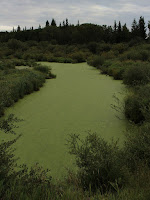
The case against green features such concepts as monotony, long stretches of sameness, blandness, stagnation.  One very real problem is invasive non-native species.  There are far too many places where such species, both on land and in the ocean, have taken over an area and overwhelmed native species. There must be a constant battle in such places to eradicate or at least control such species.  Fires, floods. and droughts create similar problems.
 
Invasive kudzu near Atlanta (public domain photo)

Blue is considered an intellectual color.  Just as red is associated with the body, blue is associated with the mind.  We don't expect a physical reaction to blue like the visceral one that often goes with red. Blue symbolizes seriousness, study, thoughtful consideration, calmness and concentration.   It is generally conceded that more people choose blue as their favorite color than any other hue.  

On the negative side, blue may be considered aloof, unfriendly, disinterested, haughty, or boring.  Blue objects may seem farther away than they are. I like light blues, and wear all shades of the color, but I have a distinctly physical reaction to dark blue rooms. They make me feel physically cold.  I could never spend any length of time in a dark blue room, nor would I have one in my home or workshop.   

Violet is another of the controversial colors.  It is situated between blue and red on the color wheel and the blue-violets are distinctly cooler than the red-violets.  Violet tones are made by mixing blue and red and the proportions of each determine the appearance and effect of the hue. From a positive viewpoint, violet may represent spirituality, luxury, status, introspection, wisdom.  But when we lived in Panama many women wore violet as a mourning color.  Because it is the closest color to the end of the spectrum — next are ultraviolet emissions not visible to the naked eye — it is sometimes associated with time, space, and the Cosmos itself. Negatively, it may produce a feeling of anonymity, inferiority, or exclusion.

Murex shell (public domain photo)
You are probably familiar with the phrase "royal purple".This refers to a dye, made from the bodies of certain mollusks, that was used to dye the clothing and possessions of ancient royal families. It was so expensive to produce that it was actually worth more than gold. No one outside family members was allowed to wear it or use anything dyed with it.  The punishment for breaking that rule could be imprisonment or death. The first rulers who were supposed to have worn garments dyed with royal purple were the semi-legendary King David and his son, King Solomon. Just recently a sizable piece of cloth in extremely good condition was unearthed at an archaeological site south of Jerusalem.  Scientists had already found fossils of the marine mollusks and ceramic containers colored by the dye.  Now they hope to find out how the fibers were spun and woven.  Radiocarbon dating has already confirmed that the cloth dates back to the time of King David.

Grey is physically neutral.  It is the only color which has no psychological properties. But that doesn't mean that everyone reacts to it in the same way. On the plus side, grays can support just about any hue.  But, unless the tone is right, grey may dampen the effect of the other color.  When the world turns grey, we are instinctively conditioned to prepare for the coming night or the looming storm.  Grey may be associated with monotony, depression, worry, weariness or old age.

Black is treated differently in various parts of the globe. In much of Europe and North America it is a "power color".  Priests, government officials,  prominent men in all walks of life wear black business suits and tuxedos.  Women choose "the little black dress" for important occasions, thinking it is slimming (it isn't) or that it will get them noticed (it makes them unobtrusive). An extreme cut,  new style, or bold dash of color is necessary to be showy, even on a red carpet.  Many designers and clothiers use black to advertise.

It is often the color of sorrow and mourning.  It is associated with mystery — even magic.  It certainly has negative connotations.  Consider the negative meanings of the following terms: blackball, blackmail, black market, black mood, black-hearted.  The greatest mystery of all is the vastness of outer space, where black holes swallow stars.

NASA Computer simulation of a black hole "eating" a star


Look for Part II later this year. Be colorful!



And sometimes, black is comforting...


 Creative Commons LicenseThis post by Annake's Garden is licensed under a Creative Commons Attribution-NonCommercial-ShareAlike 3.0 Unported License.

Sunday, April 11, 2021

Looking Forward and Backward: Spring Q and A, 2021

Spring Aliums
It is time to catch up on questions and comments left over from as far back as last winter and give some indication about topics we plan to take up in the near future.

Our family just loved the blog post about owls!  Are you planning more like it about special animals?

Let's see, we have done butterflies, fish (mostly freshwater), and owls so far. I think frogs are probably the next animals we will feature.  I can't give you a timeline yet, but I would think we will probably do it in early summer.  That seems like an appropriate time for frogs (and perhaps a toad or two).  We are so happy your family liked the owls. Here is an extra one for you.

Originals needlepoint by Annake
Are you going to do anymore quizzes and games?  We played most of the games at home and some with my sister and her kids over the phone.  We would sure like to see some more of them.

Summer flowers
We are happy to hear that you liked them. I won't promise any because we have a lot promised already and the Covid-19 situation has made scheduling anything more difficult.  I would like to do something for the Summer Solstice and some of the "midsummer madness" that has gone along with it over the centuries, and I will do that if I get the opportunity.  If not, it will probably be autumn before I can do anything along those lines.
 
Did you get any negative comments on saying that there is only one race, the Human Race?

Not really.  But, since you have brought it up, I would like to say a little more from my point of view.

Lots of colors in this multi-ethnic crowd...

Let me tell you a couple of personal stories to illustrate my "take" on life. My paternal grandmother was a Frisian immigrant fleeing disease and poverty. She crossed the Atlantic in steerage and went more than halfway across the U.S. to marry a man with whom she had corresponded, but whom she had never met. She was a midwife and an herbalist. I lived with her for a while when I was little, in a small town on the Missouri/Arkansas border. She delivered more than 150 babies in her lifetime. When she turned 75, some forty or more of the people she had delivered lined up in rows by her front fence to sing "Happy Birthday".  I was enchanted.  "Grandma, they're so pretty! They are all different colors!"  She told me that was the way it should be because that was how the Good Lord made us and He loves us all. Later she taught me not to judge people by their appearance or what they did for a living, but by how they treated other people — a lesson I never forgot.

Not too long ago, a lady with skin a little darker than mine said I couldn't understand something in her life "because you're white." I told her I have never considered myself "white". I have Native American blood and Gypsy blood, and somewhere down the line there are slanted eyes. My other grandmother had them. I don't, but one of my children does. None of those ancestors were ever accused of being "white".  I always checked "Other" on paperwork, or wrote "Human" on the line for race. The way I feel is that I'm Multicolored and I'm proud of it!

What's next in the "All About Color" series?

Right now I am researching and writing a post about The Psychology of Color. That is something that has always fascinated me. It will be the next one in the color series.  It is a big topic with many facets that are pertinent right now, so it may take some time to finish it.

 
Are you going to do something for Earth Day this year?  How about Arbor Day?

Spring foliage in the forest
Since they are so close together, we are planning to combine the themes in one post this year. We live in a high mountain area which has seen extreme drought for several years. There is no more "fire season" now: fires can and do erupt the year around.  Last year we saw devastating fires that will affect the area for decades.

We have had friends call us from towns in the valley to alert us to smoke or flames erupting on the heights above us. Autumn before last we came down from a day enjoying and photographing the aspens to emerge on the highway where more than half a dozen cars were parked every-which-way on the pavement while people took pictures of a blaze starting up the side of the mesa.  Not a single person had called the nearest fire department!!! We called for help and pretty much bullied the crowd into moving their vehicles out of the way of the engines we could already hear racing up from the nearest town.  We got our own vehicle onto a side road. Fortunately only one slope of a small ravine burned.  We plan to talk about fire prevention and safety as well as the broader aspects of the importance of preserving our global forests and the impact they have on the health of the planet.

Lots to think about and plan for!


Spring Flowers


Monday, December 14, 2020

Unfinished Business: Early Winter Q & A, 2020

Mountain landscape photo by J.J.
"Late Afternoon, Early Winter" by J.J.
Hi, Annake.  We are high school students who want to ask some questions about some of your recent posts. Please don't show our names or school because your articles are not on our reading list, but our lame on-line classes are pretty much just reading the textbooks and doing the tests that come with them. We had a teacher last spring who suggested we ought to read your Earth Day blog post and gave us the link. She also wanted us to read the one for Arbor Day. Then we looked at the 'All About Color' ones and liked those too. They are all different, but the last one was the best one yet, and we wanted to know more about it. And we want to know if you are going to do another Time Travel one? Or what is next for the Color ones?

Women in S.T.E.M. logo (public domain image)
Okay, then: Welcome, Mystery Guests! We are indeed planning more posts in the 'All About Color' series, and I have a few things to say about them today.  But first of all I want to shout out congratulations to Ishana Kumar. She won a top science prize for her project on the perception of imaginary colors. She is a 12-year-old 7th grade student who had to work within the restrictions of the corona virus guidelines. Her project may lead to a better understanding of some eye diseases, as well as  of cognitive processing. You Go, Girl!

Camo pattern

We have two new 'All About Color' features in the works, one for late Winter and one for Spring.  I'm not sure yet which one will go up first, but the topics are: "The Psychology of Color" and "The Physiology of Color". The first one will deal with subjects like imaginary colors, camouflage, how color is used to sell things, how colors affect our moods, etc.

Bee on dandelion (photo by J.J.)
The second will discuss not only how human eyes work and the problems that may afflict human vision, but will also deal with some of the remarkable ways animals see things that humans cannot.

Now, as to the Time Travel article, it was designed to get you interested in what was going on at a pivotal time in Earth's history. I have never been convinced that all of the many species that appeared during the so-called Cambrian 'Explosion' just appeared out of thin air with no links to a developmental past. Remember the sediments collected from the lowest part of our hypothetical dive? When we examined those in our respective labs back in our own time, what do you think we would have found?  Remember that they were sheltered by the sediments from the increasing supply of oxygen on the surface. Many such organisms are alive and thriving in oxygen-free or oxygen-poor environments such as deep sea deposits, caves, and deep mines today.

Black Smoker in Atlantic (public domain image. NOAA)
Black Smoker in Atlantic
Now I am going to give you a "magic word": EDIACARAN. And here is a link to follow (These Bizarre Ancient Species Are Rewriting Animal Evolution) into a field that is growing rapidly with findings from many parts of the globe. Read the side entries. Learn as much as you can and make your own decisions about the 'Explosion'.  Keep track of the dates given and I think you will see why I set the time for our 'expedition' when I did. Have fun. Look hard at everything. Scientists were once "stumped" by the strange appearance of one of the Ediacaran specimens until someone else walked into the room and pointed out that they were looking at it upside-down. (Look up Hallucigenia: the "Which end is up?" controversy has been solved by new, better fossils and the electron microscope.)

Thought bubble graphic

Ask questions. Never stop asking questions. Probably the most important word in any language is "Why?" As any harried parent will tell you, it is usually the first question children ask, and they employ it ruthlessly. The second most important question is probably "How?".  But very high on my personal list of important questions is the one that begins,"But what if...". That one will take you places!

As for whether there will be another tine travel adventure, J.D. and I will think about it. Personally, I would like to look at the relative speed at which birds and mammals repopulated the planet after the disappearance of the dinosaurs. In the meantime, stay safe and well — and do your homework!

Geometric needlepoint border sample 1
You have shown several new border patterns lately as outlines or graphs.  I work better if I can see things done in finished needlepoint. Is it possible to show some of the patterns done that way?


Geometric needlepoint border sample 2
Of course it is. I will have to look at some back issues. so it may be a while before I get caught up, but I will put several on this post. Some of the ones from "Something Fishy" were not meant for needlepoint or cross-stitch, but rather for outline stitching or crewel.  But I do samples of new counted cross-stitch, tent stitch, or solid upright Gobelin stitch before I file them, so those should be fairly close to the surface. Choose your own color schemes. You may want to do figures like flowers, hearts, and strawberries in natural or conventional colors, or you may want to experiment. If you are following a geometric design, then the light and dark values should stay as close to the original design as possible, regardless of the color scheme. Happy stitching!

Geometric needlepoint border sample 3
We had a lot of fun with the Thanksgiving games. Thanks for those. How did you think of them? Are you going to do more of them in future blogs?

You are very welcome. I'm so glad you liked them. I always used games in all my years of teaching, so I'm accustomed to making them. They are more fun than tests (and can tell a teacher just as much about the progress of the class). We played a lot of forms of Jeopardy, too. Look for New Year's games on December 26th, for sure, and there may be something for Valentine's Day, but that hasn't been decided yet. I'm thinking about something for Easter, too, especially if travel and gathering restrictions haven't been lifted by then.
Hearts needlepoint border sample
I loved the mask! Did you make it? Have you made any others?

Closeup of beads & concho on mask
I did not make it. It was made for me as a gift and meant to be worn on my chest as a neckerchief, but it was easy for me to adapt it into a mask. I am working on a couple of designs of my own. I had a whole box of broken necklaces, "orphan" earrings, beads and other items that could easily adorn a bandanna. Unlike the original design, which I hope to wear as a neckerchief again someday, the new masks will have decorations that can easily be removed so that the mask can be laundered. Look for pictures sometime in mid-January.


Hey, I liked the fish stories. Got another one?

We were fishing one of the many mesa lakes early one summer morning. I like peace, quiet, and space when I fish. All three were somewhat lacking where we were and I was about to suggest we move. Some guy with an over-sized, loud, power boat was zooming in and out between boats bragging about his boat and his catch, although he only showed a medium-sized rainbow trout.  He swung around ahead of us and my line went slack. I was pretty sure he had cut it, which did not endear him to me.

Crayfish (public domain photo)
I was reeling in my line. When it broke the surface, I saw I had a passenger — a crayfish nearly a foot long. Just then Mr. Obnoxious pulled up alongside, too close for comfort.

"What are you fishing for, Honey?", he yelled at me.

"Oh, no," I called back in my sweetest voice. "I'm not fishing. I'm teaching this crawdad to water-ski!" I held up the crustacean in question.

With a facial expression somewhere between affront and alarm, Mr. O. gunned his motor and roared away to annoy people in another part of the lake. Once he stopped laughing, my husband started the trolling motor and moved off in the opposite direction to find a more peaceful spot. Then I gently released the crayfish, thanked it, and dropped it back into the lake.

I wish you fair weather and good fishing.


Strawberries needlepoint border sample


 Creative Commons LicenseThis post by Annake's Garden is licensed under a Creative Commons Attribution-NonCommercial-ShareAlike 3.0 Unported License.

Contact Us

Name

Email *

Message *

Blog Archive