I apologize for taking so long to answer questions from your e-mails and our conversations at shows. I'll try to catch up on some of them now.

Why is it called Spanish blackwork? (See Basic Blackwork, Part I, Oct. 6,2013.)
Because it became really popular in Spain and spread from there to much of Western Europe. The patterns and techniques were introduced into Spain by the Moors, who invaded Spain from Morocco in the year 711 AD and ruled parts of it for nearly 800 years. The Moorish embroidery was done on wool with silk, gold, and silver threads. The style gained greatly in popularity when it began to be done on cheaper and more readily available linen. There is a widespread story that blackwork was brought to England by Catherine of Aragon, the Spanish first wife of King Henry VIII, but this is not accurate. Chaucer describes blackwork in his Canterbury Tales, written between 1387 and 1400, so it was well established long before her arrival in 1509. Nevertheless, there's little doubt her marriage to the king made it even more popular. It was widely used for the clothing and linens of royalty and nobility throughout the reign of Queen Elizabeth I -- and beyond. This type of embroidery was popular in Renaissance Italy, as well as in Switzerland, Germany, and the Low Countries, although each area had its individual style. Altogether, this was the period of the most lavish costumes in human history. There's a lot of history to be found in needlework!
 |
| Redwork embroidery (antique Lithuanian tablecloth) |
Is blackwork always done in black?
No, although it is usually done in a single color. Even when its popularity while done in black was at its height, it was rivaled by redwork. This was done in deep red with embellishment in gold and silver thread. When the Muslim religion began to have an influence on the Byzantine Empire (330 to 1453 AD), a style of redwork spread from Constantinople northward into Bulgaria, Romania, the Caucasus and Russia, reaching as far north as Finland. (Lots of geography in needlework, too.) It remained very popular in Russia throughout the centuries. A lady who recently visited Russia assures me that it is still abundantly available in gift shops there today. The Finnish work, done in a deep purplish-red (called “Turkey Red” in my youth) is still very similar to that done in the Byzantine Empire a thousand years ago.
 |
| A sample of drawn/pulled thread whitework |
“Blackwork” can also be done in white. You would think this could legitimately be called “whitework”, wouldn't you? However, this would dismay many of our Scandinavian friends, for whom “whitework” is a specialty. They will tell you it isn't “whitework” unless it is used in combination with drawn-thread work or pulled-thread work.
Finally, there is a version of this stitchery which is done in multicolor and is quite attractive. This is called Holbein embroidery, in honor of Hans Holbein the Younger, a German painter who was court portrait painter for King Henry VIII. Many of his works show amazing examples of embroidered clothing and accessories. (see the portrait of Jane Seymour above). Holbein embroidery will be the subject of a future blog.
 |
| Owls, done in a modern version of Holbein embroidery |
 | |
| Unicorn (in progress) in white floss - NOT "whitework" |
The word “diaper” came into English from the French language, indicating a fabric with a distinct repeating pattern. Used originally for a rich silk fabric, it came to be associated with soft white linen or cotton fabrics used for tablecloths and towels. (Don't tell me you've never grabbed up a dishtowel for the baby in an emergency!) Finally, the term was applied to any all-over fabric pattern made up of small repeated motifs or units of design (often geometric figures) connected with each other by straight or curved lines. Now the word is used here in the USA primarily for baby bottom coverings -- most of which contain no fabric at all. Just for fun, I traced the word from French to Latin and finally back to an old Greek word, diaspeirein. It is the root of both “diaspora” and “dispersion”, and originally meant to sow seeds. Eventually it came to mean “to scatter “ -- whether seeds, patterns, or people. If you are collecting diaper patterns, you might want to check this page on String-or-Nothing.com. In the meantime, I'm still inventing and adapting patterns of my own and will have some for you to download on a future blog.
 |
| Her Highness is NOT amused! |
I know a “katana” is a Japanese sword; why did you name your cat Katana?
Katana is also a form of calligraphy in which the characters end in curved points like cat's claws. The cat got her name because when she was a kitten she thought she was a ninja. Sneak attacks were her specialty. The first time she met J.D., she flew through the air, snatched the doughnut he was eating out of his hand, and disappeared with it. The look on his face was priceless. If only I had had a video camera running! She will be twelve in June, so she is too old and fat for ninja antics now. But she can still race up the stairs and across the back of the couch at a pretty good speed. Her “official” name is Princess Katana, but we don't use her title in her presence. She's already vain enough.
 |
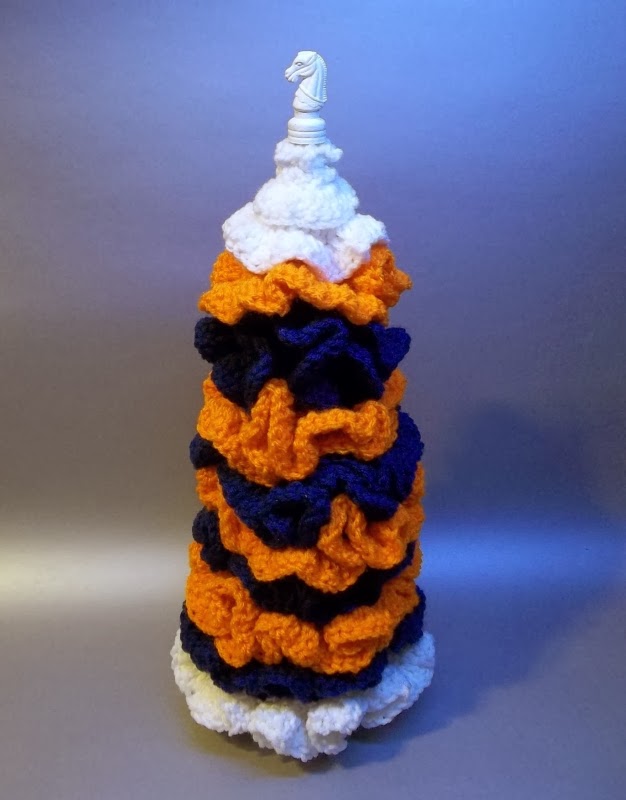
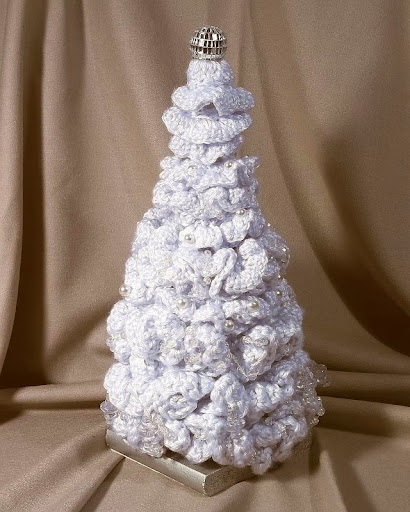
| "Feliz Navidad," a one-of-a-kind crocheted tree |
Love the [crocheted] trees! Do you sell the pattern?
No, I'm sorry, I don't. Each one is really a unique yarn “sculpture”: there isn't a single pattern. So much depends on the weight and texture of the yarns, the size of the dowel I'm mounting the tree on, the height of the tree, the color combination I'm trying to emphasize, the weight and number of ornaments I may be adding, the type of finial for the top, etc. You can probably see at least 3 basic tree shapes in the photos on the November 21, 2013 blog post. There are several more that aren't illustrated. The trees are crocheted in independent layers, and the number of layers varies from tree to tree. I modify the layers as I go along to get the effect I want. Sometimes I start at the bottom and work upwards. At other times, I start in the middle and work both ways. I may use 6 or 7 different hooks in one project. Sorry I couldn't be of more help, but I'm delighted you liked the trees!
There were also several questions about the puppets, which I will answer in the next Q and A blog. There will also be a puppet pattern to download.
Keep the questions coming!
Annake
 This post by Annake's Garden is licensed under a Creative Commons Attribution-NonCommercial-ShareAlike 3.0 Unported License.